
Introduction: What AMD FSR 4.1 Brings to Upscaling
When AMD introduces a new version of FidelityFX Super Resolution, expectations are always a bit complicated. On one hand, users hope for meaningful improvements in image quality. On the other, they expect performance gains—or at least no regressions. With AMD FSR 4.1, the picture turns out to be somewhere in between.
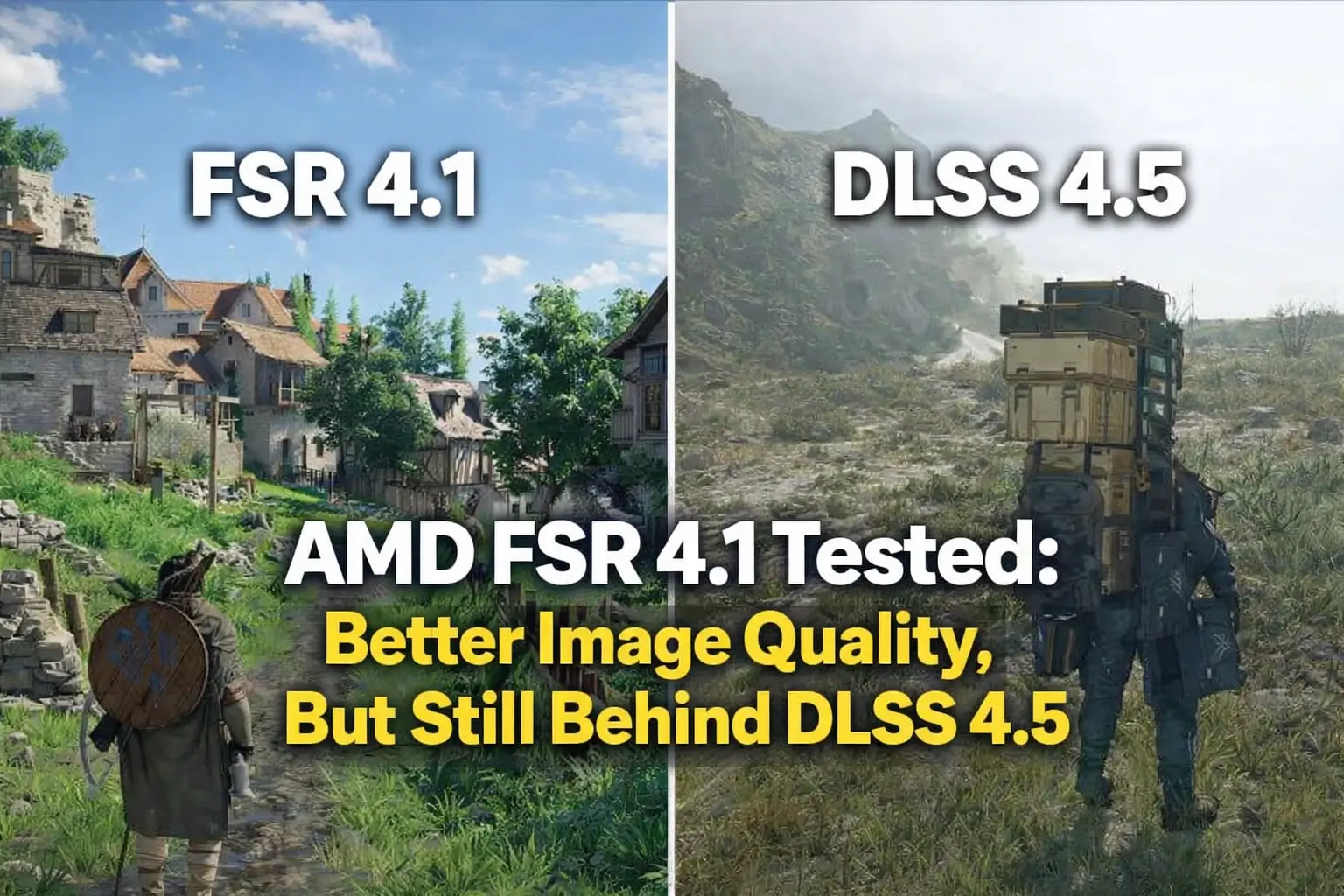
According to early testing conducted by ComputerBase, this new iteration clearly refines visual output compared to FSR 4. Yet at the same time, it struggles to fully close the gap with NVIDIA’s DLSS 4.5, especially when it comes to consistency and stability.
And that contrast—progress versus limitation—is exactly what makes FSR 4.1 interesting.
Table of Contents
What FSR 4.1 Actually Changes Compared to FSR 4
At its core, FSR 4.1 is not a complete reinvention of AMD’s upscaling technology. Instead, it builds directly on the foundation of FSR 4, refining what already exists rather than replacing it.
The most notable change lies in the updated AI model. This revised approach focuses primarily on improving detail reconstruction, especially in complex scenes. Small elements like foliage, distant objects, and environmental textures are handled more carefully, resulting in a visibly sharper image in many situations.
Interestingly, FSR 4.1 is delivered through the Adrenalin 26.3.1 driver and works on Radeon RX 9000 series GPUs. In supported titles—particularly those already using FSR 3.1 or newer—the technology can even be applied automatically, without requiring explicit in-game support.
That kind of seamless integration hints at AMD’s broader strategy: making FSR upgrades more accessible and less dependent on developer implementation.
Real Game Testing: Crimson Desert and Death Stranding 2
To understand how these improvements translate into actual gameplay, ComputerBase tested FSR 4.1 in two visually demanding titles: Crimson Desert and Death Stranding 2.
The evaluation focused on both static image quality and motion behavior—two areas where upscaling technologies often reveal their weaknesses. Particular attention was given to vegetation, fine details, and how objects behave during movement.
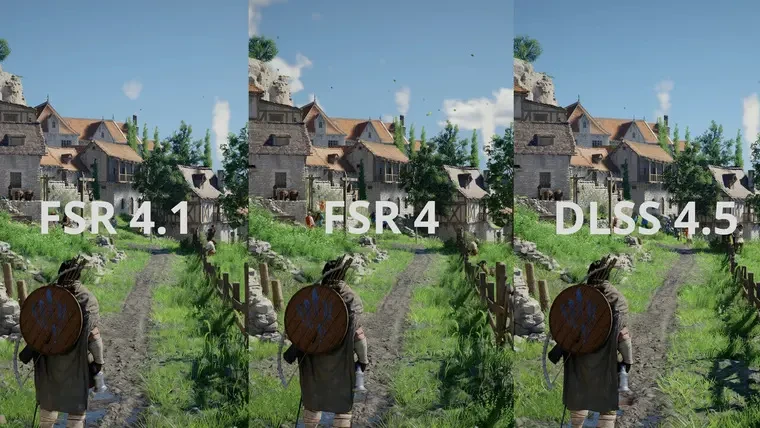
In Crimson Desert, the difference is immediately noticeable. Grass, trees, and smaller environmental details appear more defined, giving scenes a richer and more layered look. The improvements are not subtle—they’re the kind of upgrade you can spot even without zooming in.
At the same time, some familiar issues are partially reduced. Artifacts such as ghosting (trailing behind moving objects) and disocclusion errors (visual glitches when hidden objects become visible) are less pronounced than before.
However—and this is where things get complicated—the improvements don’t come without trade-offs.
In certain scenes, new distortions appear. These can affect image stability, making motion feel slightly less consistent. It’s not always obvious at first glance, but over time, especially during movement-heavy sequences, the inconsistencies become noticeable.
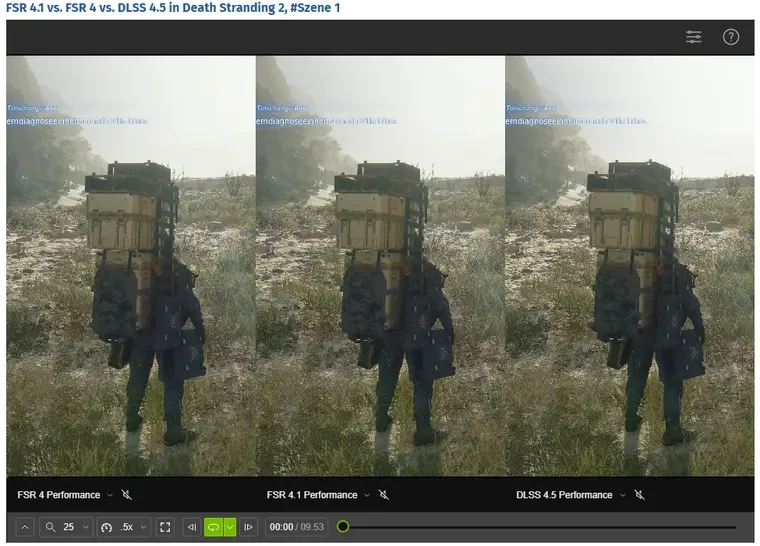
In Death Stranding 2, the differences between FSR 4.1 and FSR 4 are less dramatic. The visual gains are more subtle, and in some cases—particularly during rain—fine details can even degrade slightly.
This uneven performance across different scenarios highlights an important reality: FSR 4.1 is not universally better in every condition.
Image Quality: Sharper Details, But Not Always Stable
If there’s one clear takeaway, it’s that AMD has made progress in detail reconstruction.
FSR 4.1 produces a cleaner, more refined image than its predecessor in many cases. Fine textures are better preserved, and environments feel more coherent overall. The technology is clearly moving in the right direction.
But image quality isn’t just about sharpness—it’s about consistency.
And this is where FSR 4.1 still struggles. While artifacts like ghosting are reduced, they haven’t disappeared entirely. More importantly, the stability of the image—how consistent it looks frame to frame—can still fluctuate.
In fast-moving scenes or complex lighting conditions, this lack of stability becomes more apparent. The result is an image that sometimes feels less “locked in” compared to more mature solutions.
Performance: Minimal Gains, Mostly Neutral Impact
One of the more surprising findings is that FSR 4.1 doesn’t significantly impact performance.
Despite the improved image quality, frame rates remain roughly in line with FSR 4. This suggests that AMD has managed to refine its AI model without introducing additional computational overhead.
While this might sound like a positive—and it is—it also means there’s no meaningful performance boost to offset the remaining visual inconsistencies.
In other words, FSR 4.1 improves quality without costing performance—but it also doesn’t give you extra performance headroom.
The Bigger Picture: Why DLSS 4.5 Still Leads
Even with these improvements, the overall conclusion remains clear: AMD is still playing catch-up.
DLSS 4.5 continues to deliver a more stable image with fewer artifacts. Its strength lies not just in sharpness, but in consistency—how reliably it maintains visual integrity across different scenarios.
FSR 4.1 narrows the gap, but it doesn’t close it.
And perhaps more importantly, it highlights the difference in approach. While AMD is refining its existing framework, NVIDIA’s solution appears more mature, especially in handling motion and complex scene transitions.
That said, FSR 4.1 is far from a disappointment. It represents a meaningful step forward—just not a breakthrough.
Source: computerbase.de