External GPU on Mac Apple Silicon: A Breakthrough by Tiny Corp
For years, one limitation has quietly defined the Mac ecosystem—especially after Apple transitioned to its own silicon. No matter how powerful the internal GPU became, one thing remained off the table: support for external discrete graphics cards.
Now, that may have just changed.
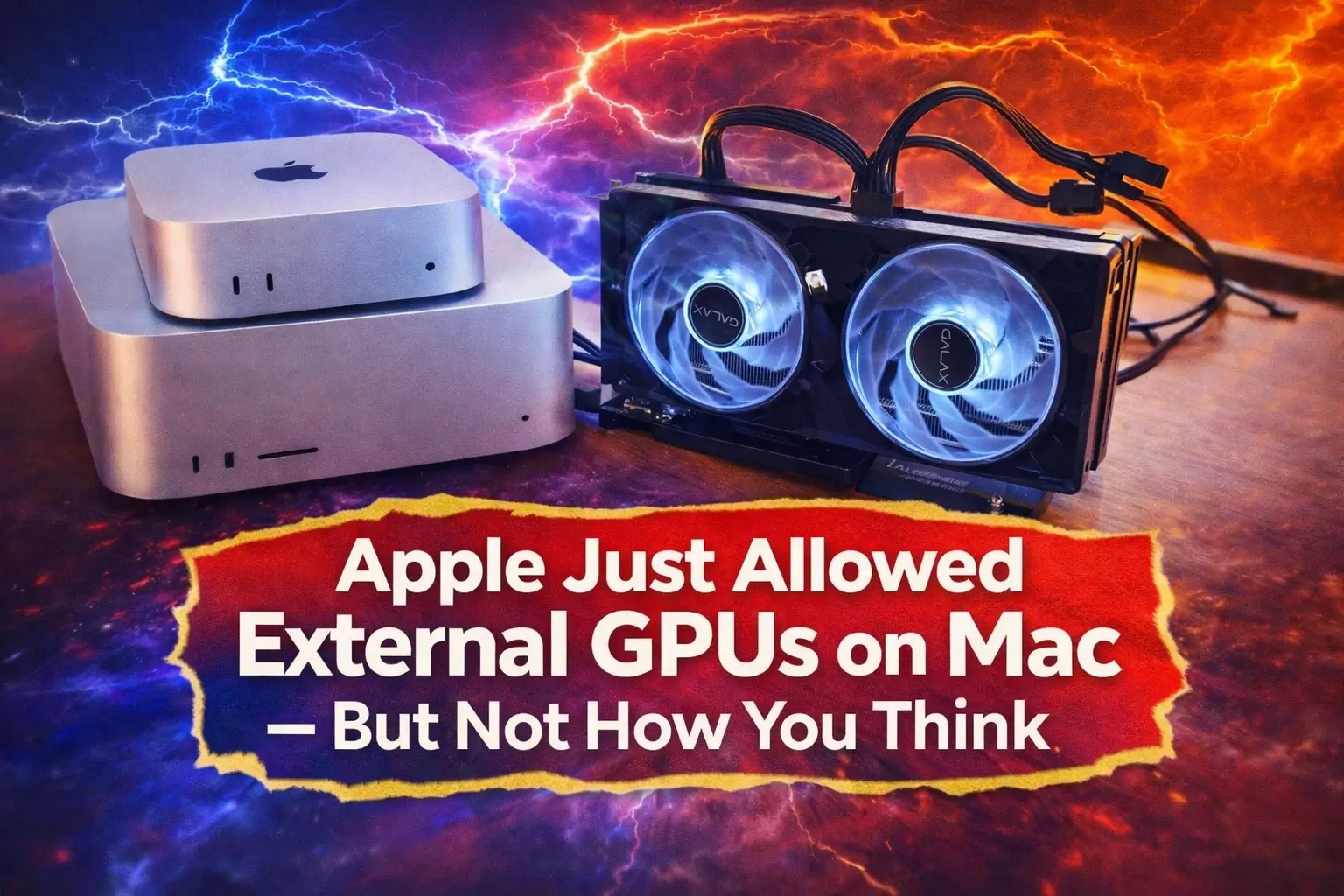
Tiny Corp, a relatively unknown but ambitious company, has announced that Apple has officially approved its drivers, enabling external GPU (eGPU) support on modern Mac systems via USB. And while that might sound like a dream come true for gamers and power users, the reality is a bit more nuanced—and arguably more interesting.
This breakthrough could open up new possibilities for Mac users, and when it comes to boosting gaming performance, the latest NVIDIA App 11.0.7 Update: DLSS 4.5, Auto Shader Compilation & Key Improvements introduces exciting advancements like DLSS 4.5 and AI frame generation.
Table of Contents
A Long-Standing Limitation of Mac Hardware
Apple Silicon Macs were never designed with external GPUs in mind. Unlike older Intel-based Macs that had limited eGPU support via Thunderbolt, newer devices built on M-series chips operate within a tightly controlled hardware and software ecosystem.
Apple’s reasoning has always been clear. Its in-house chips—especially higher-end variants like the M2 Ultra or M3 Max—already deliver impressive graphical performance. From Apple’s perspective, there simply wasn’t a need to support external discrete GPUs.
But that left a gap.
Professionals working with machine learning, scientific computing, or highly specialized workloads often rely on Nvidia or AMD GPUs—not just for raw performance, but for ecosystem compatibility. CUDA, for example, remains deeply entrenched in AI development pipelines, and Apple’s Metal framework doesn’t always serve as a drop-in replacement.
Tiny Corp’s Unexpected Solution
Tiny Corp appears to have done something many assumed was impossible.
The company previously demonstrated what it claimed to be the first external GPU solution connected to a modern Mac via USB. At the time, it raised eyebrows, mostly because Apple Silicon systems weren’t supposed to allow such configurations in the first place.
Now, with official driver approval from Apple, that experiment has turned into something far more real—and accessible.
According to Tiny Corp, the installation process is now simple enough that even non-technical users can set it up without friction. That alone is a significant shift. Historically, anything involving unofficial hardware support on macOS required workarounds, patches, or deep technical knowledge.
Another notable detail is compatibility. The driver reportedly supports both AMD and Nvidia GPUs—likely through separate implementations—but still, that dual support is rare in the Mac world.
Why It Works Only for AI — Not Gaming
Before you start imagining running AAA titles on your Mac with an external RTX card, there’s an important limitation.
This solution is designed strictly for computational workloads. In practical terms, that means AI, machine learning, and other GPU-intensive calculations—not gaming.
Why does this restriction exist? Tiny Corp hasn’t provided detailed technical explanations yet, but there are a few reasonable assumptions.
Gaming on macOS involves deep integration with the graphics stack, including APIs like Metal and system-level rendering pipelines. Enabling full gaming support would require not just driver compatibility, but seamless communication between the GPU, OS, and applications in real time.
AI workloads, on the other hand, are more flexible. They often rely on compute frameworks that can interface with hardware in a more isolated way. This makes it easier to bypass some of the limitations that prevent full graphical acceleration in games.
In other words, this isn’t a hardware limitation—it’s a software and ecosystem barrier.
What This Means for Mac Users
Even with the gaming limitation, this development is more significant than it might seem at first glance.
For developers, researchers, and AI enthusiasts, the ability to connect a discrete GPU to a Mac opens up entirely new workflows. Instead of relying solely on Apple’s integrated GPU architecture, users can now tap into the broader ecosystem of AMD and Nvidia hardware.
That means access to tools, libraries, and performance characteristics that were previously out of reach on macOS.
It also lowers the barrier for experimentation. If setup truly is as simple as Tiny Corp claims, more users may begin exploring hybrid setups—using Macs for development and external GPUs for heavy computation.
Still, there are unanswered questions. Can this driver evolve to support gaming in the future? Will Apple expand official support beyond this niche use case? And perhaps most importantly, how stable and scalable is this solution in real-world environments?
The Bigger Picture: Apple, GPUs, and the Future
Apple approving Tiny Corp’s driver—even in a limited capacity—is a notable signal. It suggests a level of openness that hasn’t typically been associated with Apple Silicon hardware.
At the same time, the restriction to AI workloads reinforces Apple’s broader strategy. The company continues to prioritize its own GPU architecture and ecosystem, rather than fully embracing external hardware solutions.
So where does that leave us?
Somewhere in between.
This isn’t a complete reversal of Apple’s stance on external GPUs—but it is a crack in the wall. And sometimes, that’s all it takes for a new category of tools and workflows to emerge.
For now, one thing is clear: Macs are no longer entirely closed off from the world of discrete GPUs. They’re just stepping into it on their own terms.
Source: X (Tiny Corp)