
Radeon RX 9070 XT Performance in 4K Path Tracing: Real Benchmarks and What They Mean
There’s always a gap between marketing promises and real-world performance—especially when it comes to cutting-edge features like path tracing. That’s why hands-on benchmarks matter so much. Recently, enthusiast tester Bang4BuckPC Gamer put the Radeon RX 9070 XT through its paces in some of the most demanding modern games, all running at 4K with path tracing enabled.
What makes this test particularly interesting is not just the GPU itself, but the context: these are extreme settings, designed to push hardware to its limits. And in that environment, the RX 9070 XT gives us a clearer picture of what AMD’s RDNA 4 architecture can realistically deliver.
To further bridge the gap between demanding settings and smooth gameplay, especially in titles pushing hardware to its limits, exploring how AMD FSR 4.1 Tested: Better Image Quality, But Still Behind DLSS 4.5 functions can offer valuable insights into optimizing your gaming experience.
Table of Contents
Test Setup and Context: How the GPU Was Evaluated
Before diving into the numbers, it’s worth understanding the test environment. The system used here is about as high-end as it gets, eliminating bottlenecks outside the GPU:
- CPU: AMD Ryzen 9 9950X3D
- RAM: 64 GB DDR5
- Motherboard: GIGABYTE X870E AORUS Pro
- GPU model: SAPPHIRE NITRO+ RX 9070 XT
This matters because it ensures that the results reflect GPU performance—not CPU limitations or memory constraints. All tests were conducted in 4K resolution with FSR enabled, alongside full path tracing.
In other words, this isn’t “typical gaming.” This is worst-case, stress-test territory.
Cyberpunk 2077: Path Tracing Performance in a Worst-Case Scenario
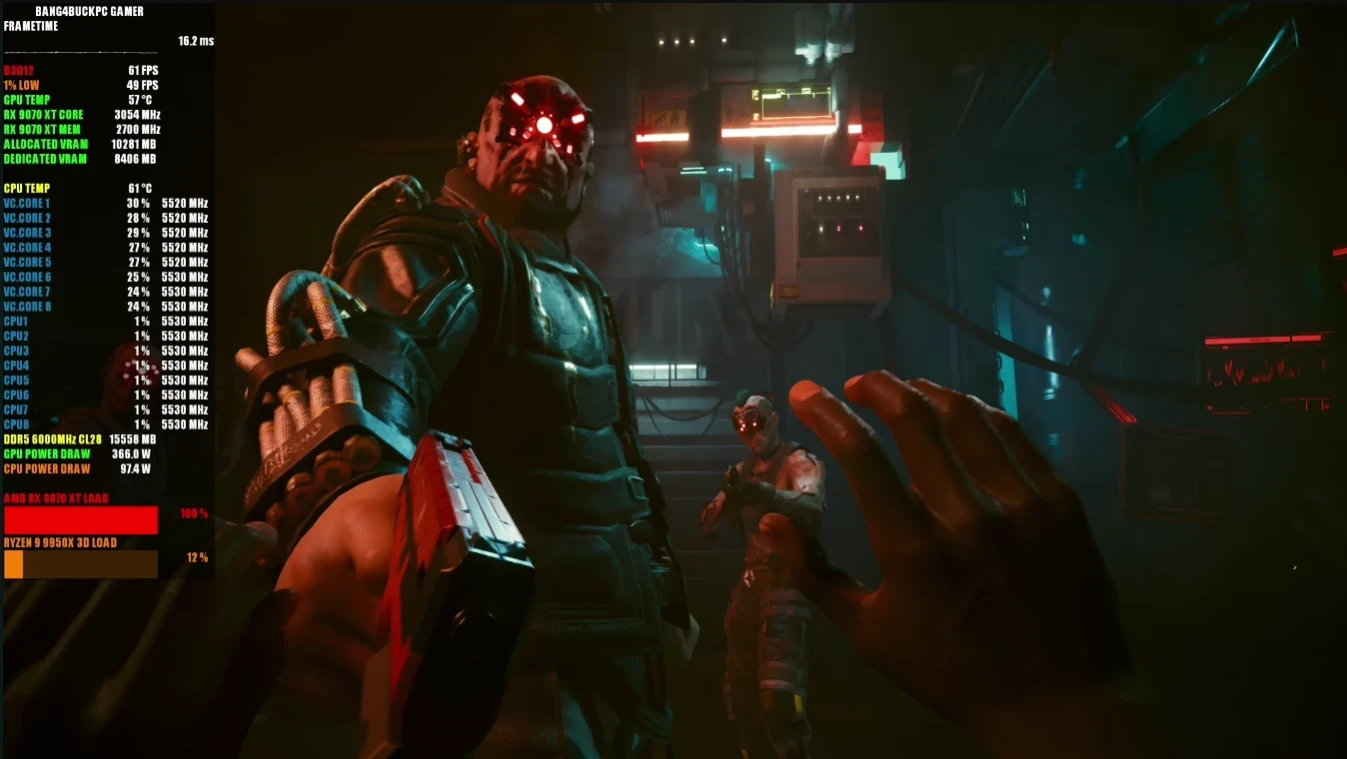
Cyberpunk 2077 remains one of the most punishing titles for modern GPUs, especially with path tracing enabled. It’s often used as a benchmark precisely because it exposes weaknesses quickly.
In this test, the Radeon RX 9070 XT delivered:
- Average FPS: 50–70
- Drops in heavy scenes: close to 40 FPS
These numbers tell an important story. On one hand, achieving around 60 FPS in 4K path tracing is impressive. On the other, those dips highlight how volatile performance can become when lighting complexity spikes.
It raises a natural question: is this “playable”? The answer depends on expectations. For single-player immersion, yes. For perfectly smooth consistency, not always.
F1 25: High FPS With Noticeable Drops
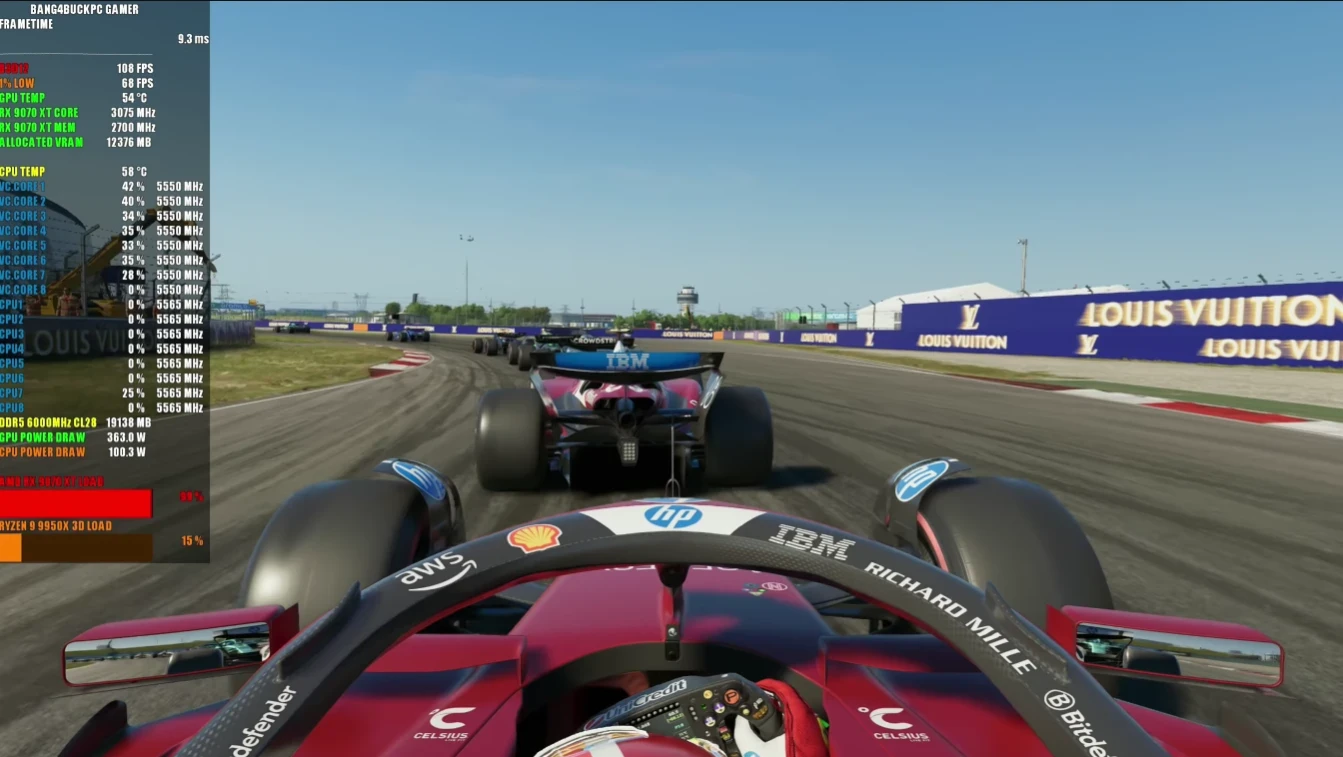
Switching to F1 25 gives us a different perspective. Racing games tend to be better optimized and more predictable in their rendering workloads.
Here, the RX 9070 XT performs significantly better:
- Average FPS: around 100
- Drops: down to ~70 FPS
This is a much more comfortable range. Even with occasional dips, gameplay would feel fluid in most situations. It also highlights how performance varies dramatically depending on engine design and scene complexity.
The takeaway? Not all path tracing workloads are equal—and the RX 9070 XT benefits from that.
DOOM: The Dark Ages: Stable but Demanding
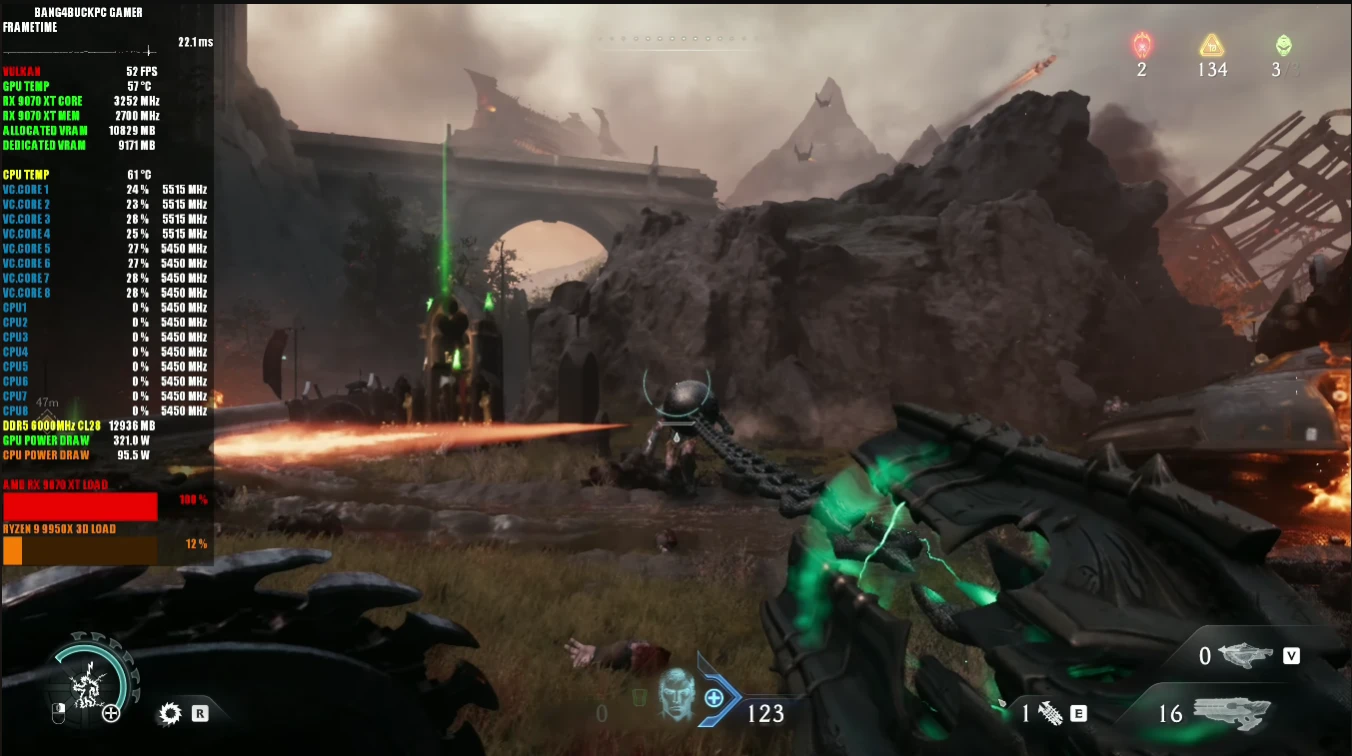
DOOM has traditionally been well-optimized, but with modern rendering techniques, even it becomes demanding.
In this test:
- Typical FPS: 50–60
- Minimums: around 45 FPS
Compared to Cyberpunk, the experience is more stable, with fewer extreme drops. However, it still sits in that borderline zone where ultra-smooth 4K path tracing isn’t guaranteed.
Interestingly, this suggests that RDNA 4 handles sustained workloads reasonably well—but still struggles when scenes become exceptionally complex.
What These Results Really Tell Us About RDNA 4
Looking at the numbers across all three games, a pattern starts to emerge.
The Radeon RX 9070 XT is clearly capable of handling 4K path tracing, which is no small feat. A few years ago, this level of performance would have been unthinkable outside of top-tier NVIDIA hardware.
But at the same time, consistency remains the challenge.
- It can hit strong average FPS
- It can maintain playable performance
- But it still dips under pressure
And that’s really the key insight here. The RX 9070 XT doesn’t fail—it just hasn’t fully conquered path tracing yet.
For gamers, this translates into a nuanced reality. If you’re chasing cutting-edge visuals and are willing to accept occasional drops, this GPU delivers. If you want perfectly stable ultra settings at all times, compromises are still part of the equation.
In many ways, this feels like a transition point—not just for AMD, but for the entire industry.
Source: Bang4BuckPCGamer