
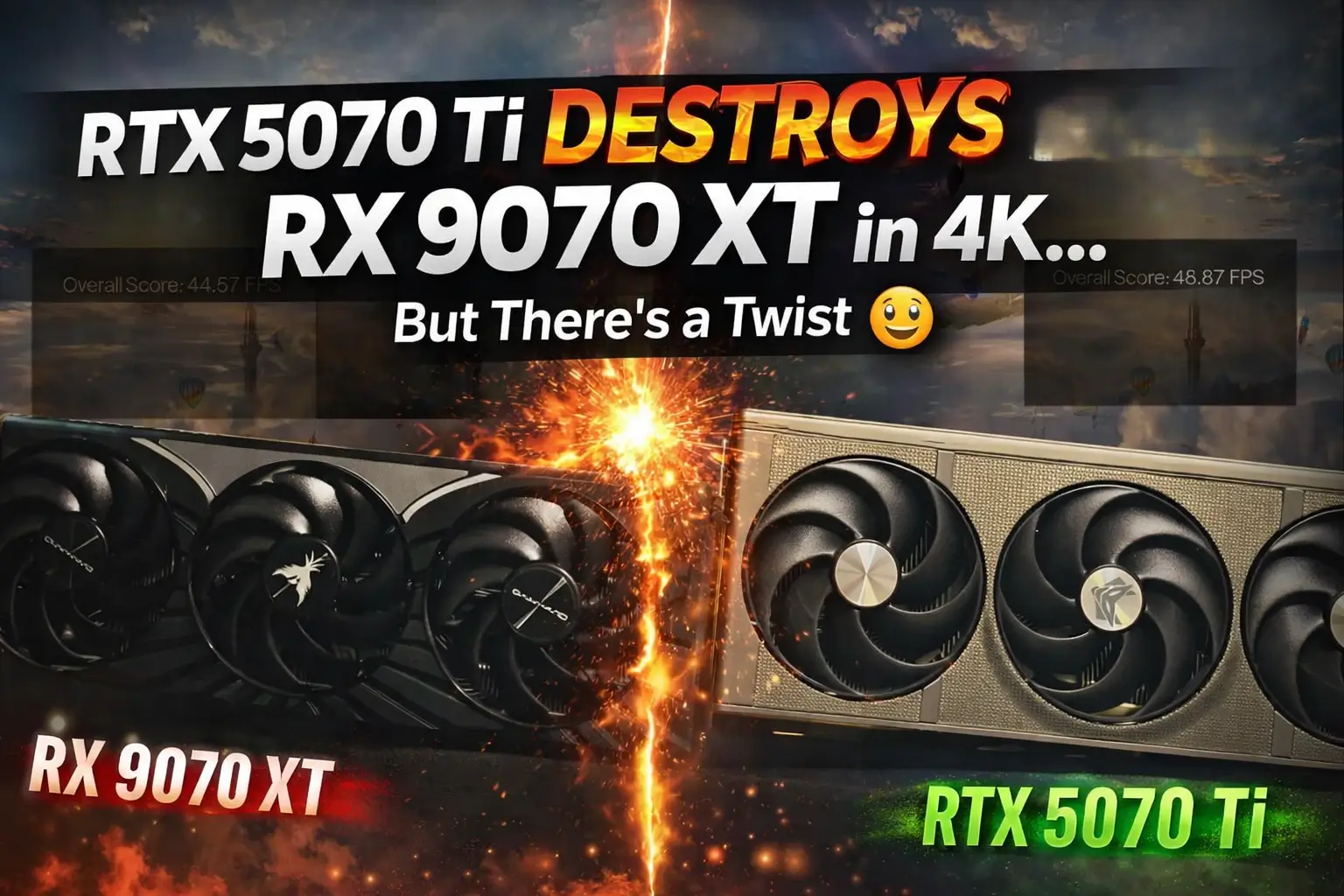
RTX 5070 Ti vs RX 9070 XT 4K Benchmark: What the Real Tests Show
When it comes to modern GPUs, synthetic charts rarely tell the full story. What actually matters is how these cards perform in real games, under real conditions — especially at 4K, where hardware truly gets pushed to its limits.
A recent hands-on comparison by Bang4BuckPC Gamer puts two highly anticipated GPUs head-to-head: NVIDIA’s GeForce RTX 5070 Ti and AMD’s Radeon RX 9070 XT. Instead of relying on theory, the test dives straight into gameplay across five modern titles, all running at native 4K resolution.
And the results? They’re more nuanced than you might expect.
While these real-world benchmarks provide valuable insights into raw GPU power, the overall gaming experience is also significantly enhanced by software innovations, as seen in the recent NVIDIA App 11.0.7 Update: DLSS 4.5, Auto Shader Compilation & Key Improvements.
Table of Contents
Test Setup and Methodology
Before diving into the numbers, it’s worth understanding the environment. Both GPUs were tested under identical conditions, paired with a Ryzen 9950X3D processor and 64 GB of DDR5-6000 memory — a setup designed to eliminate CPU bottlenecks and let the GPUs shine on their own terms.
The focus here wasn’t synthetic benchmarks or upscaling tricks. Instead, the tests were conducted in native 4K, which makes the results far more revealing for anyone planning to game at ultra-high resolutions.
Five games were selected, each representing different workloads — from strategy simulations to ray-traced shooters. That diversity is important, because GPU performance isn’t universal; it shifts depending on the engine, API, and rendering techniques involved.
Game-by-Game Performance Breakdown
The results start to form a pattern almost immediately.
In Ashes of the Singularity, a well-known benchmark for GPU scaling, the RTX 5070 Ti takes an early lead — outperforming the RX 9070 XT by roughly 17%.
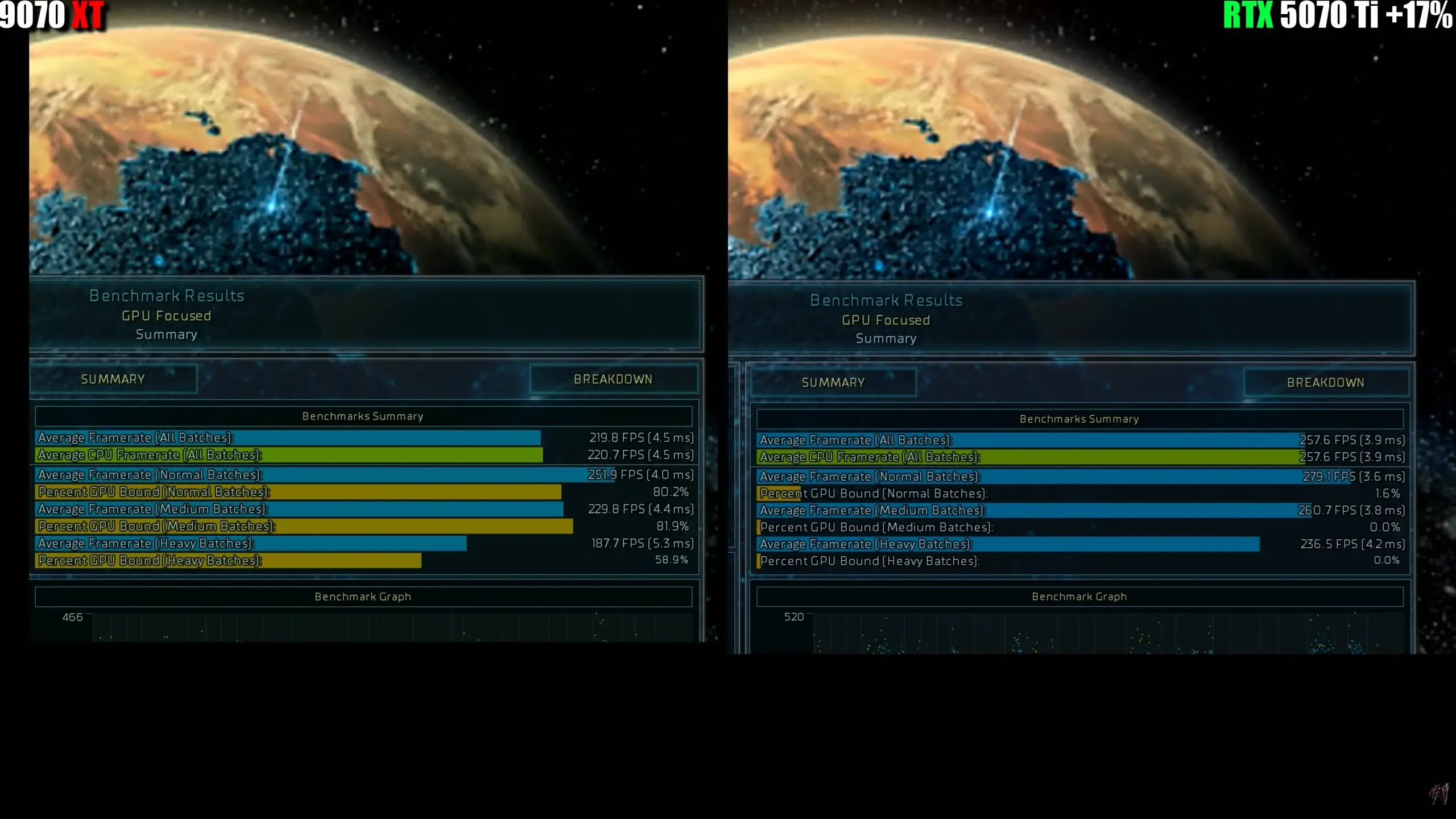
That’s not a marginal difference. In strategy-heavy workloads, NVIDIA’s architecture clearly holds an advantage.
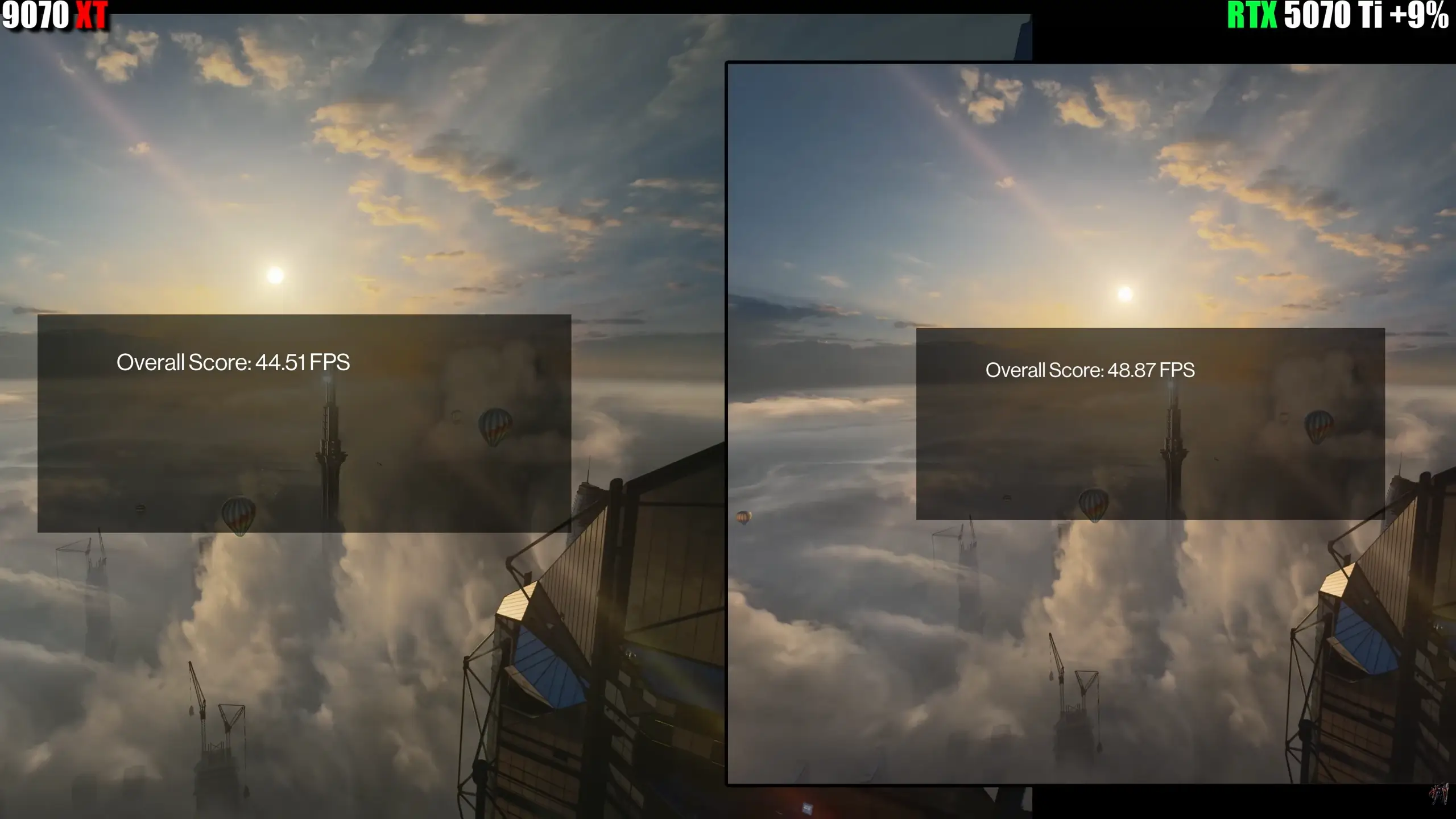
Moving to Hitman 3, the gap narrows slightly, but the trend continues. The RTX 5070 Ti maintains its lead with a 9% performance advantage.
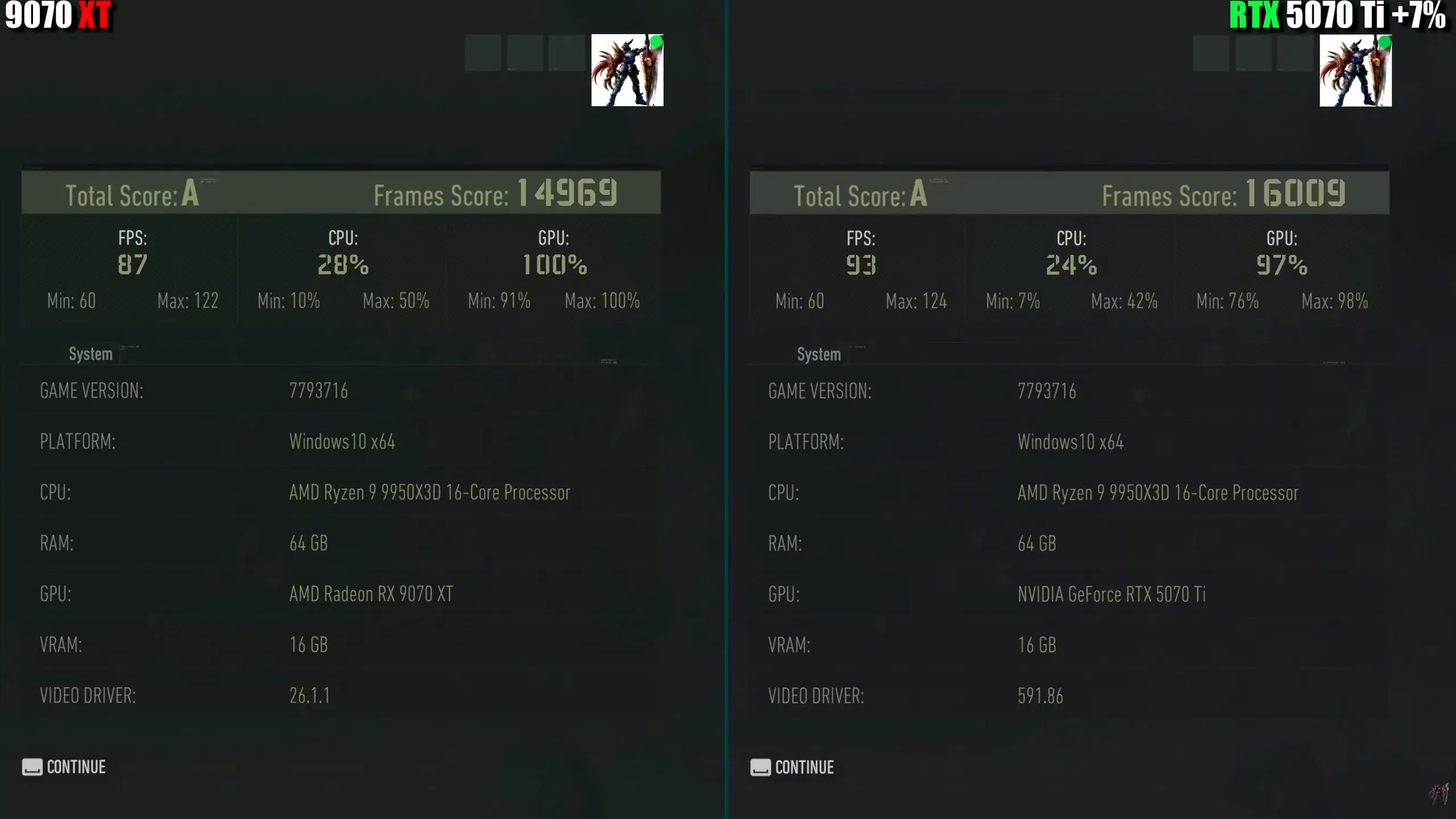
Then comes Ghost Recon Breakpoint, where the difference becomes even tighter — around 7% in favor of NVIDIA.
At this point, you might assume the story is already written. But AMD does manage to push back — just barely.
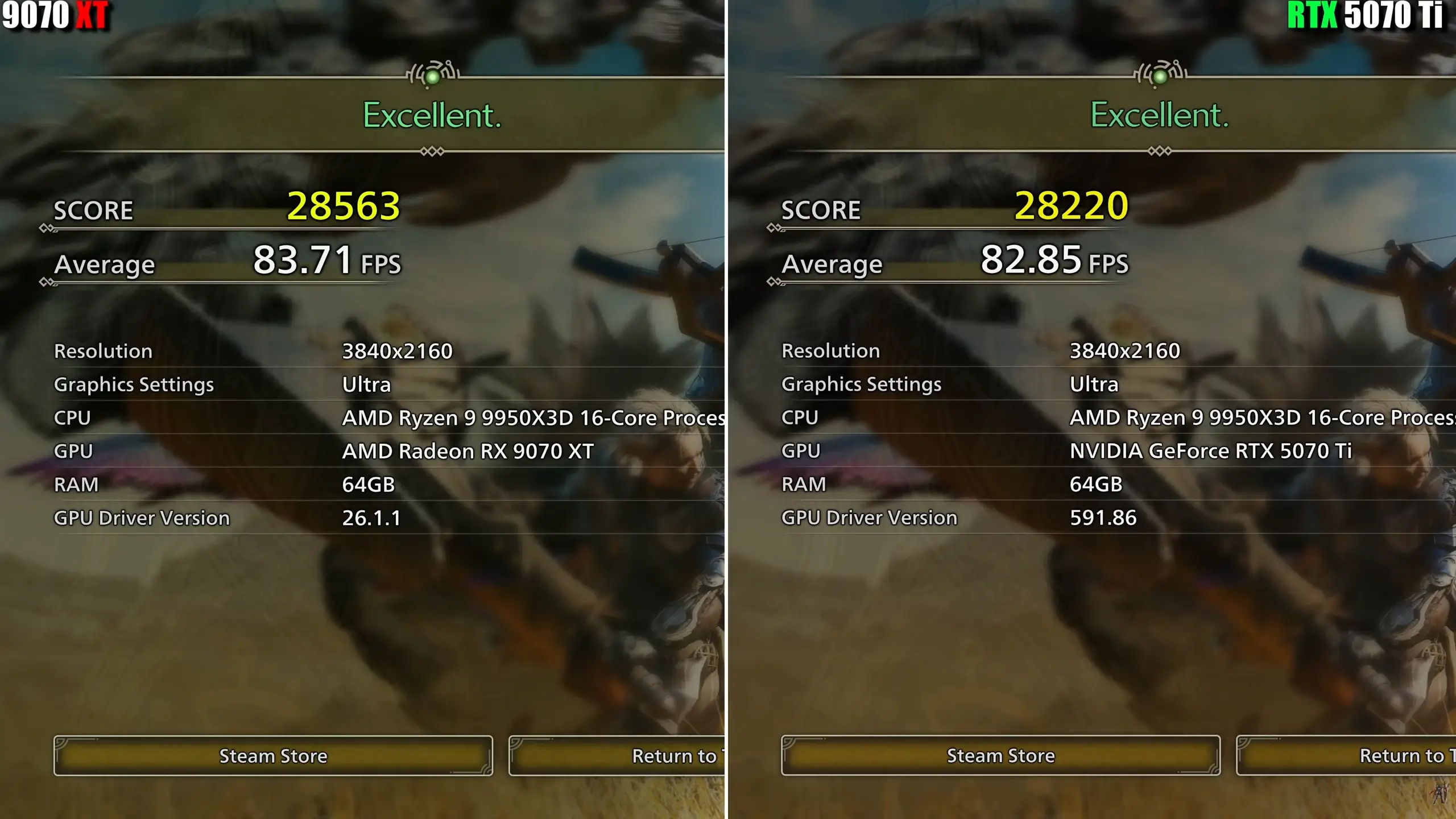
In Monster Hunter Wilds, the RX 9070 XT edges out a win, though the margin is almost negligible at around 1%.
It’s the kind of difference you’d never notice without a benchmark overlay. Still, it shows that AMD can compete in certain scenarios.
Ray Tracing and Path Tracing: The Real Gap
Everything changes when advanced rendering techniques enter the picture.
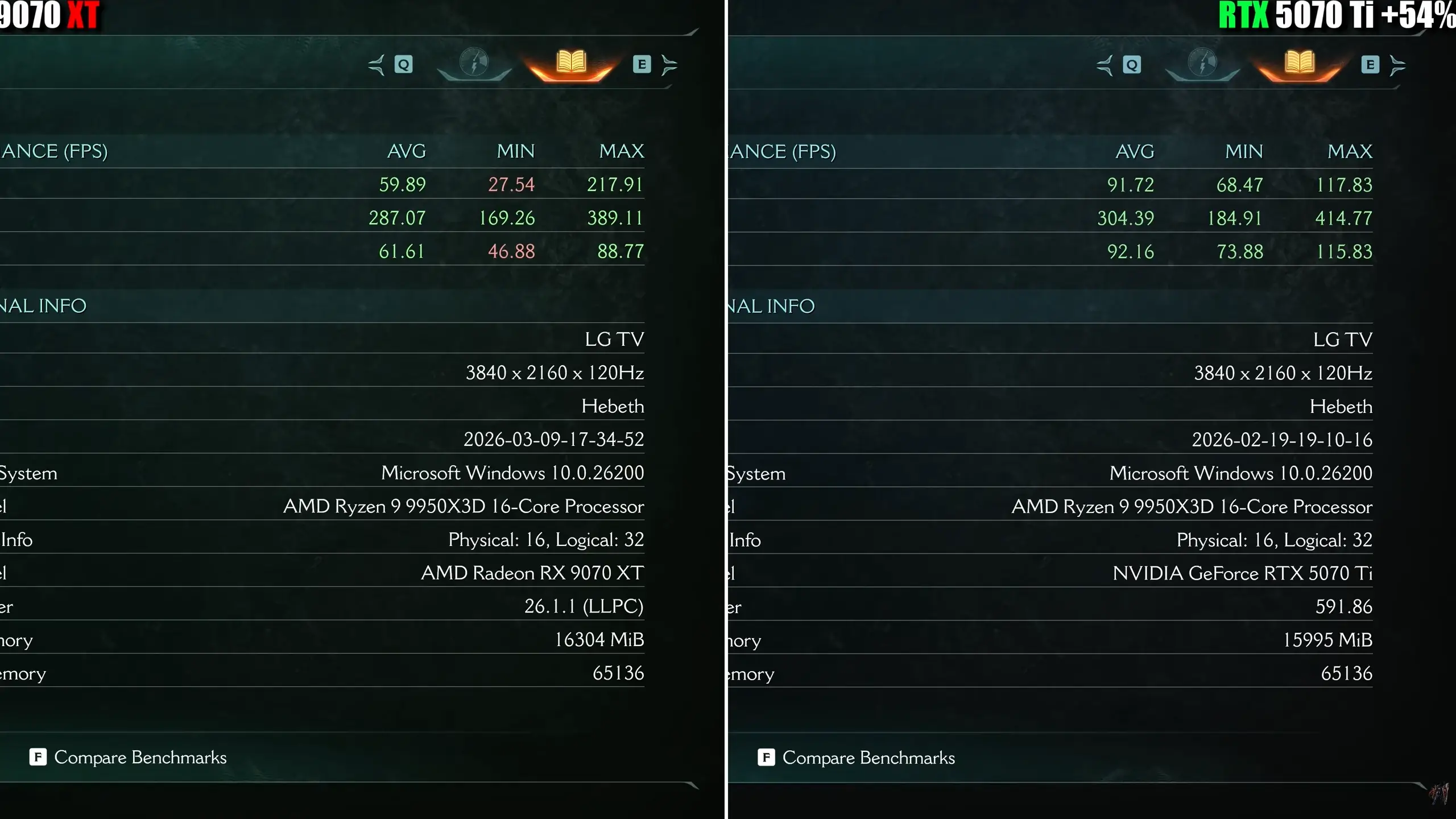
The final test — DOOM: The Dark Ages with path tracing enabled — delivers the most dramatic result in the entire comparison. Here, the RTX 5070 Ti pulls ahead by a massive 54%.
That’s not just a win — it’s a generational-level gap.
Path tracing is one of the most demanding graphical workloads available today, and it exposes architectural differences more clearly than traditional rasterization ever could. NVIDIA’s dominance in this area isn’t new, but seeing such a large margin reinforces just how far ahead it still is when it comes to ray-traced lighting and advanced rendering pipelines.
If your gaming preferences lean toward visually cutting-edge titles — especially those embracing ray tracing — this result alone carries significant weight.
Final Verdict: Which GPU Wins in 4K?
Looking at the full picture, the RTX 5070 Ti emerges as the more consistent performer across 4K gaming.
It wins in four out of five tested titles, often with meaningful margins, and absolutely dominates in path-traced scenarios. Meanwhile, the RX 9070 XT shows it can stay competitive — but only in specific cases, and even then, the gains are minimal.
So what does this mean in practice?
If your focus is traditional rasterized gaming, both GPUs are viable, and the difference may not always justify a premium. But if you care about future-proofing, ray tracing, or pushing graphical fidelity to the limit, the RTX 5070 Ti clearly has the upper hand.
And perhaps that’s the real takeaway here — not just who wins, but where they win.
Source: Bang4BuckPC Gamer

