
RTX Mega Geometry Foliage in The Witcher 4: A Glimpse Into the Future of Graphics
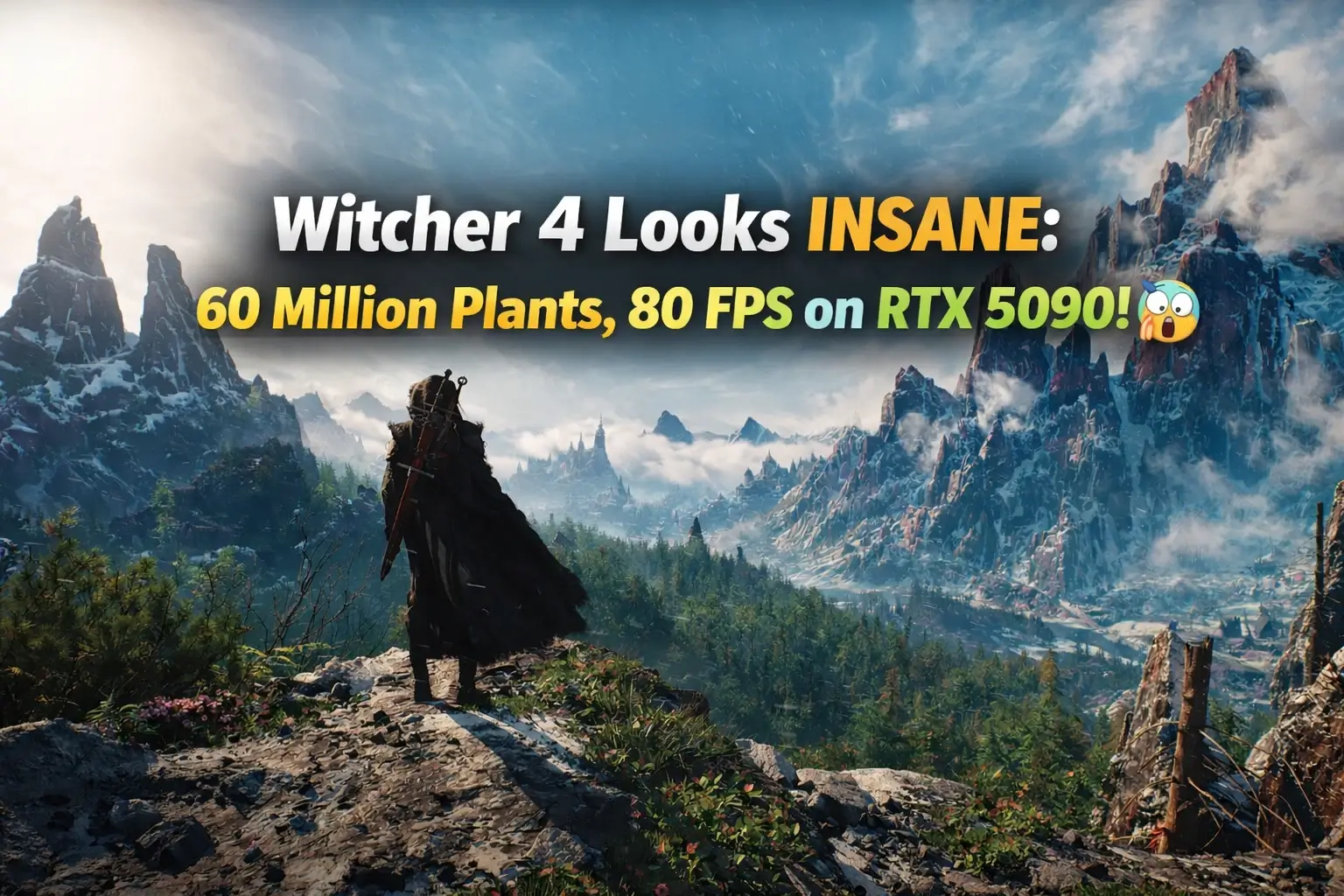
When NVIDIA and CD Projekt RED took the stage at GDC 2026, they weren’t just showing another game preview. What they revealed with RTX Mega Geometry Foliage in The Witcher 4 felt more like a statement — a quiet but confident look at where real-time graphics are heading next.
And honestly, it’s not just about prettier trees. It’s about scale, density, and how far hardware can be pushed before it breaks.
This push towards unparalleled visual fidelity, as seen with The Witcher 4, mirrors the ambitions of many developers striving to create Realistic Graphics Games: 10 Mind-Blowing Titles That Look Like Real Life that truly blur the line between virtual worlds and reality.
Table of Contents
A Massive Technical Showcase at GDC 2026
The demo presented wasn’t a small vertical slice or a carefully scripted corridor. Instead, it showcased a sprawling 5 × 5 km environment, fully loaded into memory — no streaming, no visible loading, no shortcuts.
That alone already sets the tone.
Inside this environment, the numbers start to sound almost unreal. The scene includes 60 million individual plants and around 1 million trees, each containing up to 10 million polygons.
Take a second to process that. We’re talking about levels of geometric complexity that, not long ago, would have been reserved for offline rendering — not real-time gameplay.
On top of that, the entire scene runs with ray tracing, producing dynamic lighting and highly accurate shadows. No baked tricks, no compromises — just physically accurate illumination reacting in real time.
It’s the kind of demo that doesn’t just show fidelity — it demonstrates ambition.
What Makes RTX Mega Geometry Foliage So Different
At first glance, “better foliage” might sound like a minor upgrade. But RTX Mega Geometry Foliage is less about aesthetics and more about how geometry itself is handled.
Traditionally, games rely heavily on tricks: LOD systems, billboards, and aggressive simplification. Here, the approach flips. Instead of reducing detail, the system allows an extreme density of actual geometry to exist and be processed efficiently.
What does that change?
It means forests don’t feel like repeated assets. They feel organic. Dense. Unpredictable. And more importantly, they behave correctly under dynamic lighting — something that simpler geometry often struggles with.
The result is a world that feels less “constructed” and more naturally present.
Performance Results: RTX 5090 vs RTX 4070
Of course, all of this visual complexity would mean very little if performance collapsed under the weight of it.
So how does it actually run?
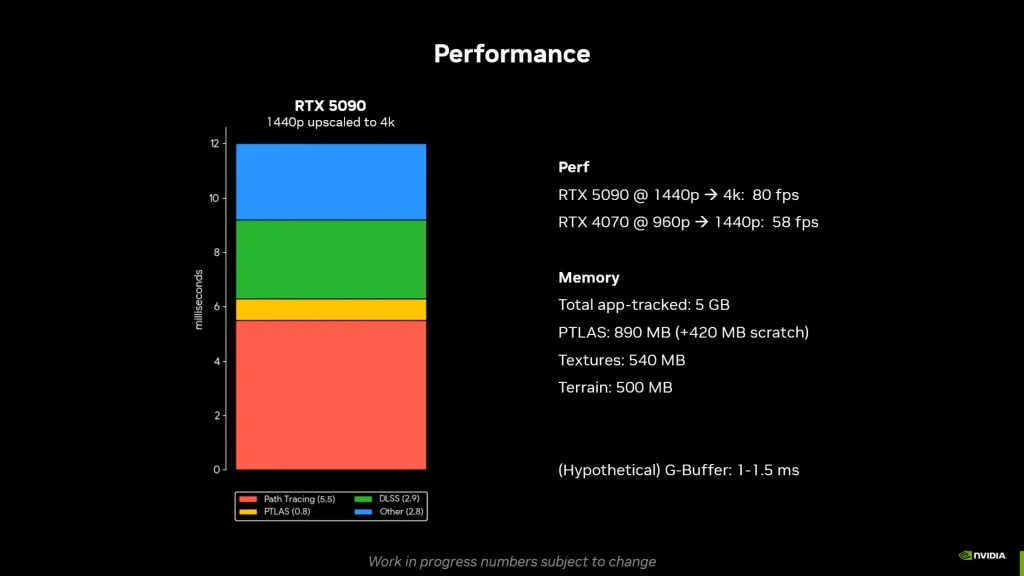
According to the demo results, the flagship GeForce RTX 5090 delivers around 80 FPS at 4K resolution using DLSS in Quality mode.
That’s not just playable — that’s smooth, high-end performance at one of the most demanding resolutions available.
But perhaps more interesting is the performance on a more accessible GPU. The GeForce RTX 4070 manages approximately 58 FPS at 1440p, also with DLSS Quality enabled.
This is where things get intriguing.
Because while the RTX 5090 shows what’s possible at the bleeding edge, the RTX 4070 suggests that this level of graphical density isn’t entirely out of reach for current-generation users.
And that balance — between ambition and accessibility — is what makes this demo feel grounded rather than purely theoretical.
Why This Demo Matters for the Future of Gaming
It’s easy to look at a tech demo and dismiss it as marketing. But this one feels different.
Not because it’s flashy — but because it tackles one of the hardest problems in real-time graphics: handling extreme geometric complexity at scale without sacrificing performance.
The absence of loading, the density of vegetation, the reliance on real-time ray tracing — these are not isolated features. They’re pieces of a larger shift toward fully simulated, persistent worlds.
And perhaps the most important takeaway isn’t the FPS numbers or polygon counts.
It’s the direction.
If this is what early implementations of RTX Mega Geometry Foliage look like, then future games may move closer to environments that are not just visually impressive, but structurally rich — worlds where detail isn’t faked, but genuinely exists.
Source: wccftech.com