Hybrid Bio-AI Computing: When Living Neurons Become Part of Artificial Intelligence
There’s something almost surreal about the idea: instead of running artificial intelligence on GPUs or specialized silicon chips, what if part of the computation came from living brain cells? Not in theory—but in a real, working system.
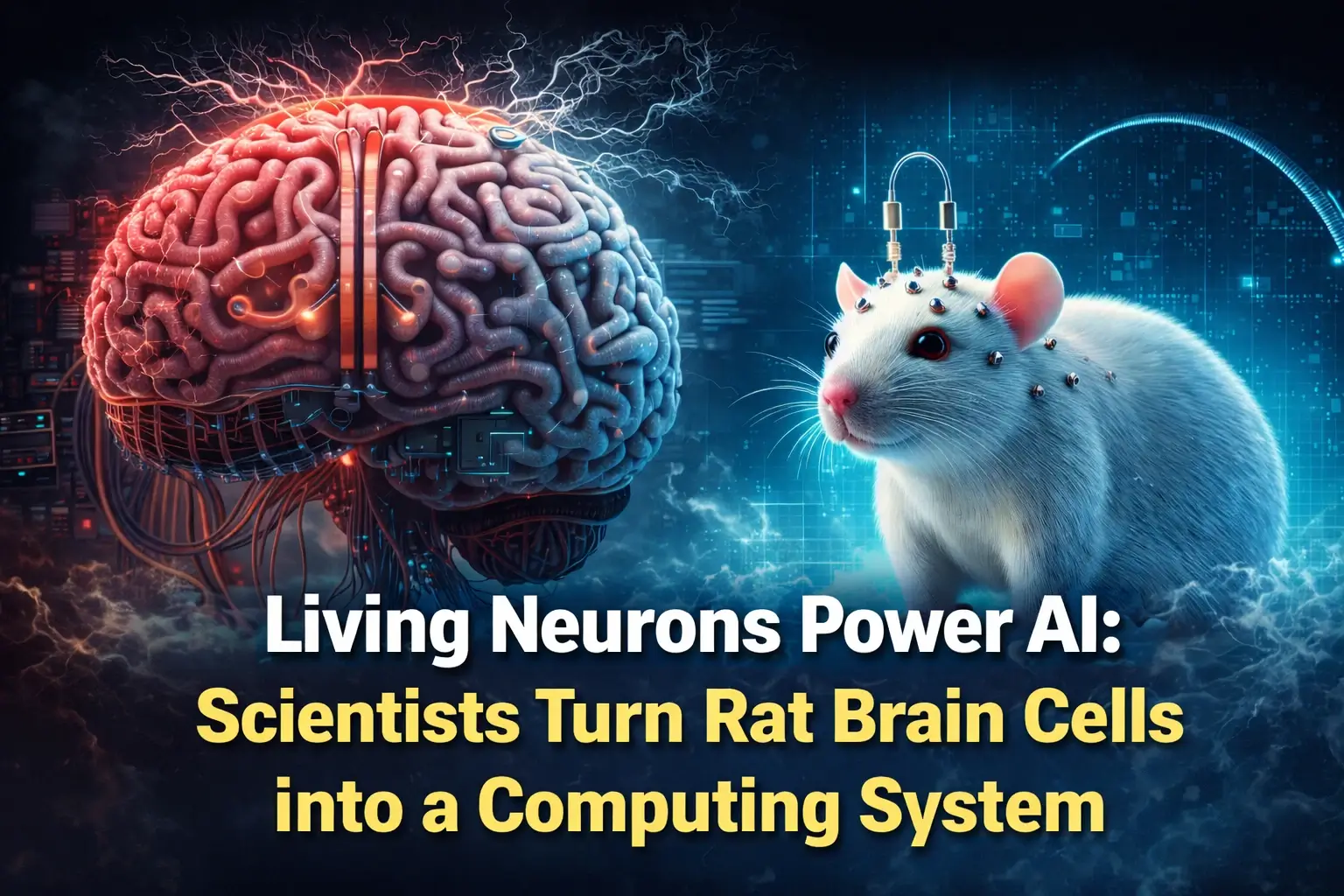
That’s exactly what researchers from Tohoku University and Future University Hakodate explored. In a carefully controlled laboratory setup, they connected a culture of rat brain neurons to an electronic system and demonstrated that these living cells could participate in solving machine learning tasks in real time.
At first glance, it sounds like science fiction. But the experiment is grounded in a very practical question: can biological neural networks complement or even replace parts of traditional AI computation?
Table of Contents
A New Direction Beyond Traditional AI Hardware
Modern artificial intelligence relies heavily on hardware—GPUs, TPUs, and increasingly specialized chips designed to accelerate neural networks. These systems are powerful, but they are also energy-intensive and fundamentally limited by their architecture.
The Japanese researchers approached the problem from a completely different angle. Instead of improving silicon, they asked whether nature’s own computing system—the brain—could be integrated directly into machine learning pipelines.
This isn’t about replacing digital AI altogether. It’s about exploring whether biological systems can handle certain types of computation more efficiently or differently. And that’s where things get interesting.
How Scientists Turned Rat Neurons Into a Computing System
The core of the experiment involved neurons extracted from the cortex of a rat. These cells were cultured in a laboratory environment and placed onto a substrate equipped with a microelectrode array.
This setup is crucial. The microelectrode array acts as a bridge between biology and electronics. It allows researchers to send electrical signals into the neural culture and, at the same time, record how the neurons respond across multiple contact points.
In practical terms, this means the scientists could “communicate” with the neural network—stimulating it with input signals and observing its output patterns in real time.
The result is a hybrid system: part living tissue, part electronic interface. And together, they form a functional computational unit.
The Role of Reservoir Computing in Bio-AI
To make this system useful for machine learning, the researchers used a framework known as reservoir computing.
Instead of training the entire network (which would be nearly impossible with living neurons), they treated the biological neural culture as a nonlinear “reservoir.” This reservoir transforms incoming signals into complex patterns of activity.
Here’s the key idea:
- The input signal is fed into the neuron culture
- The neurons naturally produce rich, dynamic responses
- Only the output layer—typically a simple classifier—is trained
This approach cleverly sidesteps the need to control or fully understand every internal connection within the biological network.
In the experiment, the system received time-based input signals—sequences that needed to be recognized or predicted. The electrical responses generated by the neurons were then recorded and used to train a lightweight output model.
Despite its simplicity, the hybrid setup successfully learned to distinguish between different input signals and perform basic machine learning tasks in real time.
That’s a significant milestone. It shows that living neural tissue can actively participate in computation—not just passively exist as a biological curiosity.
What This Means for the Future of AI and Brain-Machine Interfaces
So what does all of this actually lead to?
At the very least, the experiment demonstrates that biological systems can be integrated into computational loops. That alone opens up a range of possibilities.
Researchers are already discussing potential applications in brain-machine interfaces, where biological and electronic systems work together seamlessly. Instead of simply reading brain signals, future systems might incorporate living neural components directly into their processing pipelines.
There’s also the broader concept of hybrid computing systems—architectures that combine the flexibility and adaptability of biological networks with the precision and scalability of digital electronics.
Of course, this is still early-stage research. The tasks performed by the system were relatively simple, and scaling such an approach presents enormous technical and ethical challenges.
But the principle has been established: living neurons can function as part of a computational system.
And once that door is open, it’s hard not to wonder how far it could go.
Will future AI systems include biological components? Could hybrid bio-electronic intelligence outperform purely digital models in certain domains?
We don’t have those answers yet. But experiments like this suggest that the boundary between biology and technology is becoming more fluid than we once imagined.
Source: tomshardware