AMD FSR 5: A Different Vision of AI Upscaling in Gaming
When NVIDIA introduced DLSS 5, the reaction from gamers wasn’t exactly unanimous. Some were impressed, others… less so. The criticism mostly centered around one thing: the way AI seemed to reshape visuals into something that didn’t always feel like the original game anymore.
Now AMD is stepping in with its own answer — FSR 5, internally known as Scarlet Cortex. And instead of trying to outdo NVIDIA on the same terms, AMD is taking a noticeably different path. One that feels less about control… and more about adaptation.
Speaking of AMD's commitment to evolving its upscaling technology, it's valuable to look back at how previous iterations have performed and improved, such as when we explored AMD FSR 4.1 Tested: Better Image Quality, But Still Behind DLSS 4.5 in detail.
Table of Contents
A New Answer to DLSS 5 — But With a Twist
At first glance, FSR 5 belongs to the same category as DLSS 5: AI-powered rendering designed to improve image quality and performance. But once you look closer, the philosophy behind it starts to diverge.
DLSS relies heavily on pre-trained neural networks — massive datasets, offline training, and per-game optimization. AMD flips that idea on its head.
Instead of forcing a model trained elsewhere onto every game, FSR 5 learns directly from the game you’re playing. It doesn’t come with a fixed understanding of how things should look. It develops that understanding over time.
And that subtle shift changes everything.
How FSR 5 Learns Directly Inside the Game
This is where things get interesting — and slightly unconventional.
FSR 5 starts with a base neural model trained on general rendering principles. But from that point forward, the real learning happens locally, in real time. As you play, the system observes the game’s rendering pipeline: textures, lighting, materials, and artistic direction.
Over the course of about 5 to 15 minutes, depending on resolution and settings, the model adapts. Lower resolutions require more time — simply because there’s less visual information to work with initially.
What emerges is something closer to context-aware rendering. The AI isn’t guessing based on external data. It’s learning the identity of the game itself — its color palette, lighting behavior, and visual language.
That means one crucial thing:
FSR 5 aims to preserve the original artistic intent rather than reinterpret it.
Key Features That Define Scarlet Cortex
The technical foundation behind FSR 5 is deeper than it might seem at first glance. Several core features shape how it behaves in real-world scenarios.
First, there’s real-time neural rendering. Instead of rebuilding geometry or heavily modifying scenes, FSR 5 enhances what’s already there — improving lighting, materials, and atmospheric effects without rewriting the visual style.
Then comes adaptive online learning. No need to download game-specific profiles or patches. The system evolves automatically as you play, continuously refining its output.
Another important layer is hardware integration. FSR 5 uses INT8 quantized inference on RDNA 4 AI accelerators, meaning the workload is handled by dedicated AI hardware rather than competing with traditional shader resources.
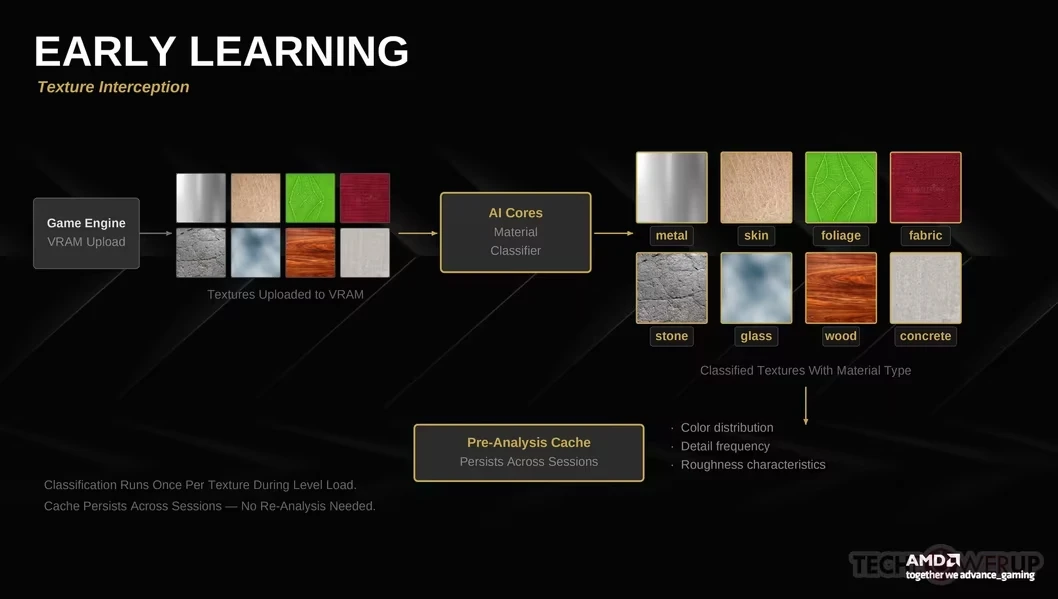
There’s also a driver-level analysis pipeline. Before the first frame is even rendered, the system analyzes textures, geometry, and shaders, classifying surfaces and rendering intent. This adds a slight delay during loading — typically 1 to 3 seconds — but it’s mostly a one-time cost thanks to caching.
Finally, AMD introduces a two-tier integration model. FSR 5 works universally at the driver level, but developers can optionally integrate an SDK to provide additional data or restrict behavior (especially useful in competitive multiplayer environments).
Real-World Visual Results: Sharpness vs Authenticity
So how does it actually look in practice?
Early tests — including comparisons in titles like Cyberpunk 2077 and Hogwarts Legacy — reveal a clear pattern.
The first thing you notice is sharpness. The image becomes noticeably clearer, almost as if the resolution has increased. Details pop more, edges feel more defined, and the overall presentation looks cleaner.
But unlike DLSS 5, FSR 5 doesn’t aggressively restyle the scene.
That said, it’s not entirely free from quirks.

In Cyberpunk 2077, reflections behave differently. Some become softer, while others — like neon signs — appear more prominently, even when they weren’t clearly visible before. It’s subtle, but noticeable.

In Hogwarts Legacy, colors become more насыщенные, and detail improves significantly. However, character faces sometimes shift slightly — and in certain cases, quite dramatically. It’s a reminder that the system is still interpreting data, not just reproducing it.
There are also occasional artifacts — small areas where the image briefly degrades. But considering the technology is still unfinished, this isn’t entirely surprising.
Overall, the key takeaway is this:
FSR 5 enhances rather than transforms.
It leans toward fidelity, not reinterpretation.
Performance, Hardware, and Limitations
Of course, better visuals always raise one question: what’s the cost?
Unlike traditional upscaling solutions that boost performance, FSR 5 behaves a bit differently. In current tests, enabling it actually results in a small performance drop, even in Performance mode.
In Quality mode, that drop sits around 8–10%, along with an increase in VRAM usage of roughly 400 MB.
This might seem counterintuitive, but it reflects the complexity of real-time AI processing. You’re not just scaling pixels — you’re running an adaptive neural system alongside the rendering pipeline.
Hardware support is also limited for now. FSR 5 is expected to work only on Radeon RX 9000 series GPUs, similar to how FSR 4 was restricted to newer architectures.
At launch, support will be limited to DirectX 12, with potential expansion to Vulkan and DirectX 11 later.
Game compatibility will initially depend on AMD’s driver-level whitelist. Over time, however, AMD plans to move toward a blacklist model, where FSR 5 is enabled by default in most games — except those where it could create issues, such as competitive multiplayer titles.
Why AMD’s Approach Could Change AI Rendering
What makes FSR 5 particularly intriguing isn’t just the technology — it’s the philosophy behind it.
NVIDIA’s DLSS 5 represents a top-down approach: massive pre-trained models, carefully tuned for each game. AMD’s FSR 5, on the other hand, is bottom-up. It learns, adapts, and evolves locally.
That opens the door to something bigger.
Imagine a system that doesn’t need manual optimization for every new release. One that improves automatically as you play. One that respects the unique artistic identity of each game instead of applying a universal “AI look.”
That’s the promise of Scarlet Cortex.
And while it’s still early — with some rough edges and unanswered questions — it already hints at a future where AI rendering becomes personal, adaptive, and deeply integrated into the gaming experience.
Source: TechPowerUp