

DDoS L4 vs L7 Attacks: The Difference Every Admin Must Know
DDoS attacks stopped being exotic years ago. They’re now routine for internet service providers, banks, e-commerce stores, and any service that lives online. Yet the phrases “L4 attack” and “L7 attack” still get thrown around like magic words. One admin says the pipe is saturated; another complains that login is completely choked. The symptoms feel different, and the fixes are definitely not the same.
The core distinction comes down to where the attacker decides to strike. They can hammer the transport layer to clog your bandwidth and network equipment, or they can mimic real users at the application layer to break the actual service. Knowing the difference decides which protection services you purchase, how you design your infrastructure, and what you do the moment an attack begins.
Table of Contents
Network Layers Without the Academic Overkill: Where L4 and L7 Live
The full OSI model looks impressive on a slide, but for real-world DDoS work you only need a few layers. Layer 3 (network) handles routing packets between devices. Layer 4 (transport) manages connections and ports. Layer 7 (application) understands specific protocols and apps—HTTP, DNS, SMTP, and everything else your users actually touch.
Put simply, L4 sees streams of packets identified by IP addresses and ports. It doesn’t care what’s inside those packets. L7 sees the meaning: individual requests to specific pages, API endpoints, search forms, shopping carts, and so on. A single L4 connection can carry dozens of separate L7 operations, each with its own logic and resource cost.
That’s why two attacks with identical bandwidth can feel completely different to the business. One saturates the pipe and drops every client at once. The other leaves the channel mostly free while the application server drowns in “smart” requests, leaving legitimate users staring at endless loading spinners.
What Is a Layer 4 DDoS Attack: Targeting the Pipe and the Stack
An L4 attack is blunt and brutal. The goal is to overwhelm either the available bandwidth or the resources of the network stack so legitimate packets can’t get through or are processed with painful delay. Attackers rely on volumetric floods and amplification techniques that generate huge numbers of identical packets.
Common examples include:
- Massive TCP SYN floods that fill the half-open connection table on the server.
- UDP floods aimed at a specific port or range, often with spoofed source IPs.
- Amplification attacks such as DNS amplification, where a tiny query to a third-party server produces a massive reply aimed at the victim.
To the resource owner, an L4 attack looks like a sudden, sharp spike in inbound traffic. Bandwidth graphs shoot upward, network gear starts choking, and users report that the site simply won’t load. Occasionally a few packets still sneak through, but the overall experience feels like a massive traffic jam—movement exists, but it’s agonizingly slow.
Defense against L4 attacks almost always happens upstream—at the ISP or a specialized cloud scrubbing center—where there’s massive bandwidth capacity and powerful network hardware. Techniques include edge-router filtering, Anycast distribution across multiple nodes, dropping suspicious packets, and BGP route announcements to cleaning centers. A traditional on-premise firewall simply sits too far downstream; by the time the flood reaches it, the pipe is already full.
What Is a Layer 7 DDoS Attack: Targeting the Application and Business Logic
An L7 attack doesn’t care about saturating your bandwidth. It targets the application itself. The volume of traffic can be modest, but every request is engineered to trigger the most expensive possible operation on the server.
Attackers typically:
- Hammer “heavy” pages—search forms, reports, complex filters, PDF generators, or image-heavy sections.
- Abuse API endpoints for login, registration, or password reset that touch databases or external services.
- Deploy “smart” botnets that browse the site with varied User-Agents, realistic timings, and human-like scenarios.
From the outside the attack looks quiet. Bandwidth stays moderate, packet counts don’t look crazy, but the application servers, databases, and external services are slammed. Users see pages that take many seconds to load, carts that don’t update, and orders that hang on “processing.” You’ll often notice a spike in HTTP 500 or 503 errors.
Protecting against L7 requires more than simple packet filtering. You need tools that understand protocol logic: web application firewalls (WAFs), behavioral traffic analysis, targeted CAPTCHAs, request-level rate limiting, caching, and smart architecture decisions. A good L7 filter distinguishes bot noise from real humans using dozens of signals, not just IP addresses and headers.
Key Differences Between L4 and L7 Attacks
On paper the layer discussion can sound theoretical. In practice these differences dictate your entire defense strategy—who you contract with and which metrics you watch.
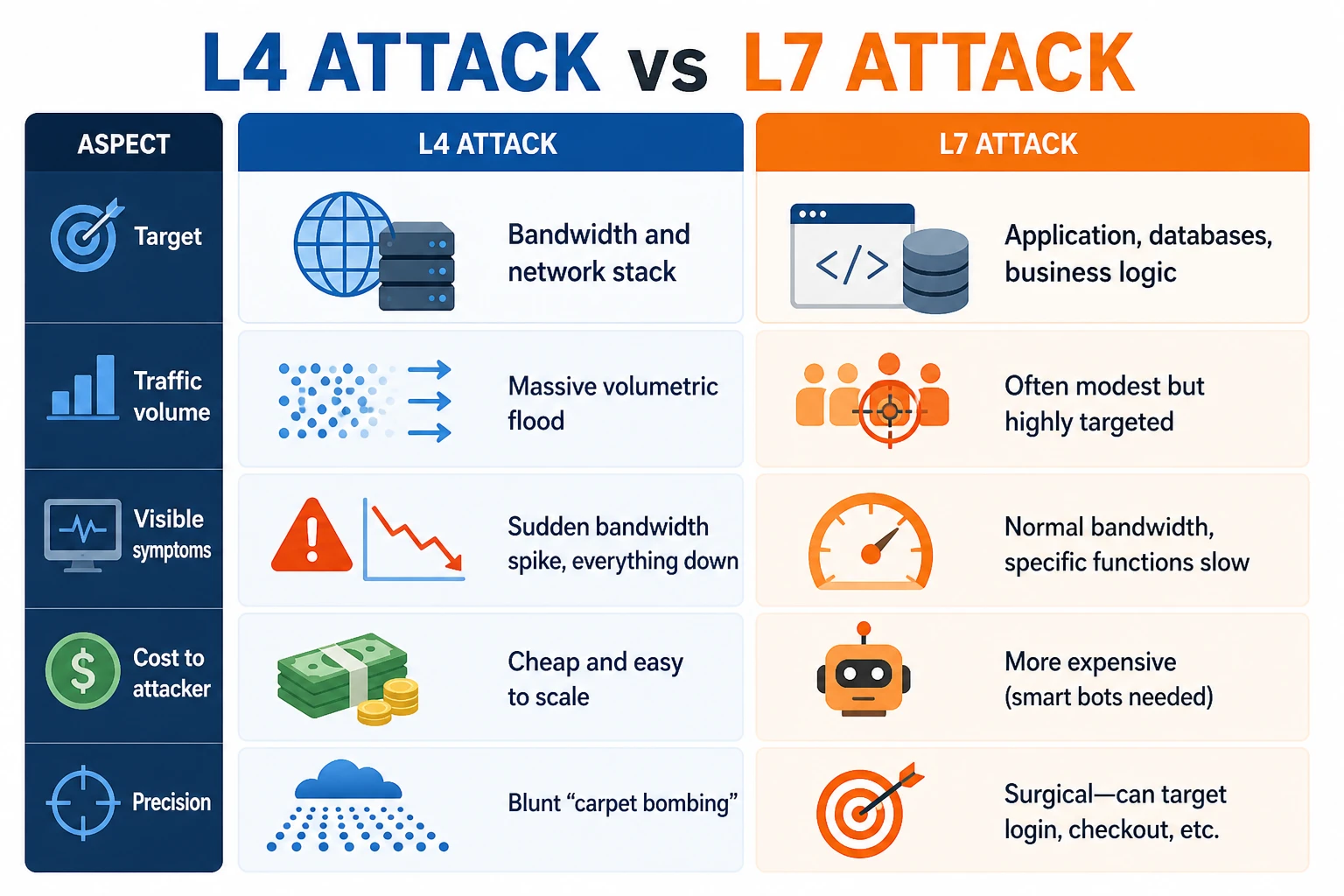
L7 attacks are usually more expensive for the attacker because they require bots that can handle HTTP, cookies, and sometimes JavaScript. But they let the attacker apply pressure exactly where it hurts the business most.
Why Businesses Need to Understand the Difference
The L4 versus L7 split directly affects which protection services you buy. Some solutions excel at scrubbing huge volumes of IP-and-port traffic but barely understand HTTP. Others are brilliant at protecting web applications but can’t survive a multi-gigabit flood at the edge.
Assuming a single “DDoS protection” service is universal is a fast way to discover that your protection only works halfway. The network provider may clear the pipe while the application still collapses under crafted requests—or the WAF may filter perfectly while the upstream pipe is already saturated.
Approaches to Defending Against L4 Attacks
Because L4 attacks are about volume, mitigation usually lives far upstream at the ISP or scrubbing center. Traffic is redirected via BGP announcements, cleaned, and only clean packets are sent onward.
Typical L4 defenses include:
- Filtering anomalous traffic by IP and port, blocking known bad sources.
- Rate-limiting connections and requests at the network level.
- Anycast routing that spreads load across many geographic nodes.
- Blackholing the attacked IP in extreme cases to protect the rest of the infrastructure.
On your own premises you can still tune TCP stack parameters, reduce timeouts, shrink half-open connection tables, and apply edge firewall rules—but these steps only matter once the upstream pipe has been cleaned.
Approaches to Defending Against L7 Attacks
L7 protection needs intelligence, not just brute force. The focus shifts to understanding HTTP requests and separating good from bad without blocking real users.
Key tools include:
- Web application firewalls that analyze request patterns and limit expensive operations.
- Targeted CAPTCHAs applied only to suspicious sessions.
- Aggressive caching of frequently requested pages and responses.
- Architectural changes—queuing heavy jobs, asynchronous processing, and separating static and dynamic content.
Application design itself becomes part of the defense. If every homepage request triggers dozens of database queries, no filter will save you when load increases even modestly. Monitoring logs and observability dashboards (Grafana and similar) help you spot anomalies in request rates, error percentages, and response times quickly.
Comprehensive Strategy: Combining L3/L4 and L7 Protection
Real attacks are rarely pure. Attackers often start with a noisy L4 flood to distract, then switch to precise L7 requests—or vice versa. Effective defense is therefore layered.
At the network edge, ISPs and scrubbing centers drop the crude noise. Closer to the application, WAFs and behavioral analysis take over. On top of the technical layers you need solid processes: monitoring, incident playbooks, and clear escalation paths with your providers.
For smaller organizations, cloud platforms that combine L3/L4 and L7 protection in one service are often the smartest choice. They hide your real IP, automatically filter multiple attack types, and handle the heavy lifting of traffic scrubbing.
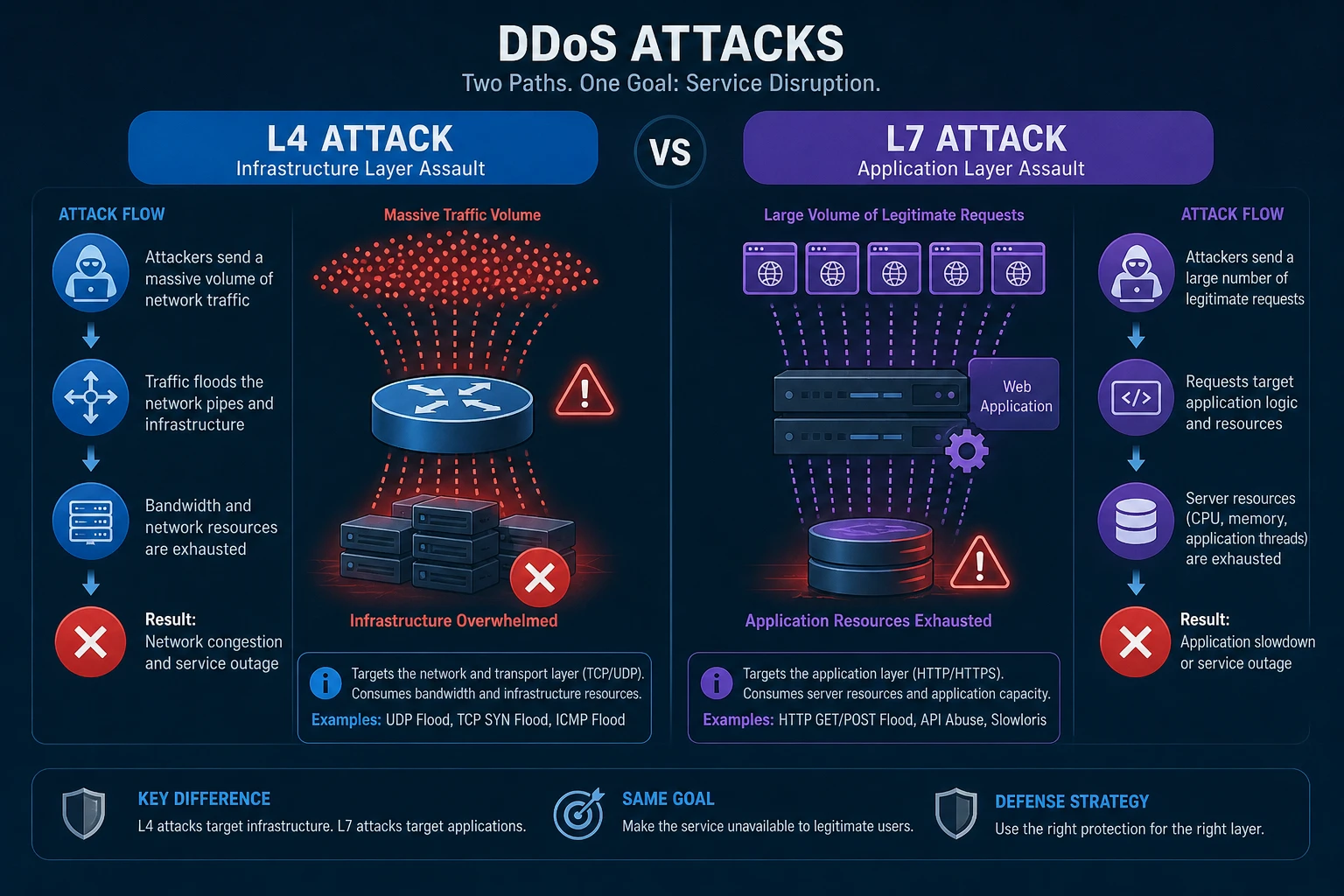
How to Identify What Type of Attack Is Hitting Your Resource
When the site goes down the first question is always “L4 or L7?” Quick diagnosis comes from looking at a few key metrics simultaneously:
- Bandwidth usage and packets-per-second on border devices.
- Number of connections and half-open states.
- HTTP requests per second, broken down by method and URI, plus 4xx/5xx error rates.
- CPU and memory load on web servers, application servers, databases, and caches.
If the pipe is saturated but almost nothing reaches your servers, it’s almost certainly L4. If bandwidth looks normal but HTTP requests to specific endpoints have exploded and your application/database is maxed out, it’s L7. A combination of both points to a mixed attack.
The better your metrics and dashboards, the less time you’ll waste arguing about whose problem it is and the faster you can act.
Common Mistakes When Choosing and Implementing Protection
Even experienced teams repeat the same errors:
- Buying only network-level protection and leaving the application layer exposed.
- Relying solely on a WAF while having no upstream volumetric defense.
- No documented incident response plan—who calls the provider, which IPs can be temporarily blackholed, decision criteria.
- Blind trust in “automatic” protection without ever testing it.
- Forgetting internal tools, partner APIs, and admin panels that are often left unprotected.
What Small and Medium Businesses Should Do
The “we’re too small to be targeted” argument no longer holds. Many DDoS campaigns are automated and hit anything in the attacker’s range. SMBs can also become collateral damage in larger campaigns.
With limited budget, focus on basics that deliver the biggest impact:
- Host critical services with providers who already offer proven DDoS protection.
- Use a CDN for static content to offload your origin server.
- Monitor simple availability, response time, and error metrics so you at least know an attack has started.
- Maintain a secondary channel or backup site for the most important functions.
Also prepare short communication templates for customers and partners. A clear, calm explanation during an incident goes a long way toward preserving trust.
When analyzing DDoS L4 vs L7 attacks in real time, clear visibility across both network and application layers is essential—raw metrics alone won’t tell the full story. A simple, self-hosted monitoring setup can make this much easier, and Install Uptime Kuma on Ubuntu (Docker + HTTPS) – Full Easy Guide shows how to quickly deploy a reliable uptime and incident tracking system that helps you spot issues before they escalate.
Conclusion: L4 and L7 as Two Different Fronts in the Same War
DDoS is no longer just a technical issue for administrators—it’s a direct business risk that affects revenue, reputation, and customer trust. Understanding the difference between L4 and L7 attacks lets you see the full picture: where your bandwidth is vulnerable, where your application might buckle, and where responsibility lies with your ISP, your protection provider, and your own team.
There is no single magic shield. But you can build a sensible, balanced defense: solid upstream L4 protection, strong application-layer controls, optimized architecture, proper monitoring, and a tested response plan. When you do, the question “DDoS L4 vs L7” stops sounding like abstract theory and becomes a practical framework that keeps your business online.