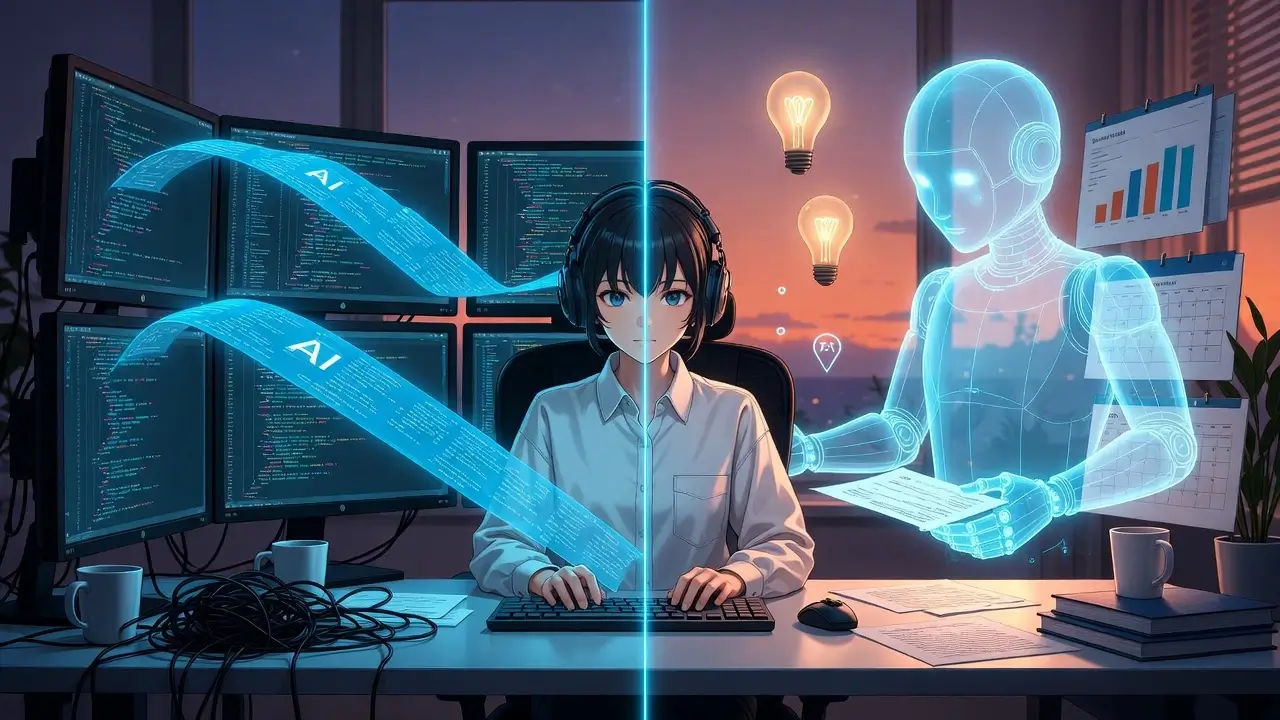
AI Took My Job—but Gave Me Twice as Much New Work
A few months ago, if you had asked me who I was, I would have answered without hesitation: “I’m a data analyst” or “I’m a software developer.” Those titles felt solid, earned after years of late nights debugging stubborn code and shipping features that actually mattered. Today, I can’t say those things with the same confidence.
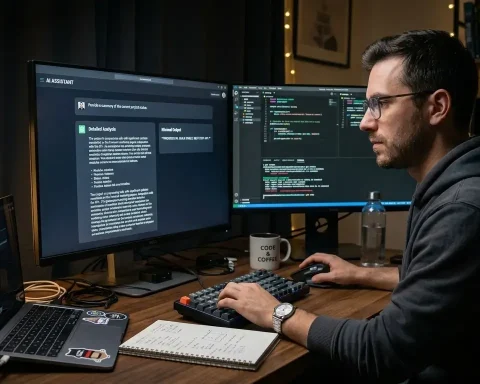
Formally, nothing major has changed. I still work in the same field and for the same company. But I no longer write code by hand. Instead, I write prompts, and Claude Opus 4.6 writes the code—often well enough that it could replace me at my own desk. Accepting this shift was not easy. My career has always been a huge part of my identity, and my professional wins heavily influenced how happy I felt overall.
I moved through every stage of grief—denial, anger, bargaining, depression—until I finally reached something like acceptance. In that space, a new sense of self is slowly taking shape. It’s still forming, and I’m examining it carefully from different angles. I’ll share more about that new identity another time. Today, I want to talk about the strange transformation I experienced: how AI took away parts of my job and, in return, handed me twice as much new work I never expected.
Table of Contents
The Day My Old Identity Started to Fade
It used to be completely normal to spend eight or ten hours writing and perfecting a single function, especially if I hit a particularly nasty bug. That level of deep focus was my normal. Now the same task takes fifteen minutes, maybe half an hour at most. Suddenly, hours of my day opened up.
At first, that felt like freedom. Then reality set in. Those freed hours quickly filled with entirely new responsibilities. I started helping the team plan projects, improving communication across departments, and onboarding colleagues who weren’t technical but wanted to use AI tools safely. I found myself teaching people not to leave passwords in code, showing them how to structure projects properly, and even considering running seminars on AI risks. After all, I was already spending my days reading the latest research papers—why not put that knowledge to use?
I realized I had stepped into a role I never trained for and barely understood. The familiar work had vanished, replaced by a pile of unfamiliar tasks that left me feeling lost and overwhelmed.
From Writing Code to Writing Prompts
This shift felt disorienting. When I felt confused, I did what I always do: I went looking for research. Knowledge has always been my anchor.
My core question was simple: Am I losing my mind, or is AI genuinely taking work away only to dump even more on top of us?
I couldn’t settle the sanity question, but I found solid evidence about how work itself is transforming.
The Research That Helped Me Make Sense of It
One of the most helpful overviews I found was the paper “Deskilling and Upskilling with Generative AI Systems.” It draws on several large studies (some behind paywalls) and explores two opposing effects of AI.
Deskilling happens when AI lets a junior employee perform at the level of a senior one without ever learning the deeper skills. There’s no pressure or opportunity to grow those capabilities.
Upskilling occurs when someone delegates routine, time-consuming tasks to AI and uses the freed mental space for more complex, creative, or strategic work.
The paper and supporting studies paint a clear picture of acceleration:
- Programmers build websites 30% faster with ChatGPT.
- Non-programmers using AI can create websites almost as quickly as experienced developers (though quality details vary).
- Sales teams close deals faster with AI assistance.
AI clearly speeds things up. But does that speed translate into less work or higher pay?
Deskilling vs. Upskilling — What the Studies Show
A massive Danish study titled “Large Language Models, Small Labor Market Effects” tracked 25,000 workers and found almost no reduction in hours worked or increase in earnings. An American study, “Shifting Work Patterns with Generative AI” from Microsoft, showed similar results—people using the tools saved about 1.5 hours per week on email reading. That was it.
It felt anticlimactic. Where did all that saved time go?
The Jevons Paradox in the Age of AI
This pattern has a name: the Jevons Paradox. In the 19th century, economist William Stanley Jevons observed that more efficient steam engines used less coal per unit of work, yet overall coal consumption rose because cheaper energy encouraged more widespread use.
Modern researchers applied this idea to AI in “AI and the Extended Workday.” Their conclusion was blunt: employees work faster, but companies expect more output. No one sends you home early just because you finished early. The instruction becomes, “Great—now solve the next thing.”
Another piece, “As AI’s Power Grows, So Does Our Workday,” reported that professionals in AI-heavy fields work roughly 3.15 hours more per week than those in less AI-adopted areas. Those saved 90 minutes on email? They evaporate quickly.
Why Saved Time Never Feels Like Freedom
A Harvard-linked analysis in “Does AI Increase Productivity or Just Make Us Work More?” explains the psychology. When tasks feel easier, we lower our mental barriers. We dash off a quick draft during lunch, fix a small bug in two minutes, tweak something else “while we’re at it.” These micro-tasks add up.
We also venture into new territories we once left to specialists: “Why bother the developers? I’ll just fix it myself.” We skip necessary breaks because “it’s only a prompt—I can type it one-handed while eating.” Context switching becomes constant: one bug fixed, jump to an email, then another prompt. The work expands to fill every available moment.
The Hidden Cost — Brain Fry and Constant Context Switching
Researchers have even coined a term for this: “brain fry.” It captures the mental exhaustion that comes from continuously supervising, planning for, and correcting AI output. You’re not just doing the work anymore—you’re managing an eager but imperfect junior colleague that never sleeps.
This constant oversight, combined with rapid task switching and blurred boundaries between work and personal time, creates a subtle but heavy cognitive load. Many of us don’t even realize how drained we feel until the end of the day.
Finding My Way Forward
I’m still navigating this new reality. The old version of my job is gone, but something richer and more strategic is emerging in its place. I’m learning to embrace the upskilling path—delegating the routine, protecting deep thinking time, and deliberately building the new skills this era demands.
AI didn’t just take my old work. It forced me to evolve. And while the transition has been uncomfortable, I’m starting to see the potential on the other side.
Source: Natalia Povarova