12 Possible Futures for Humanity in the Age of Superintelligent AI
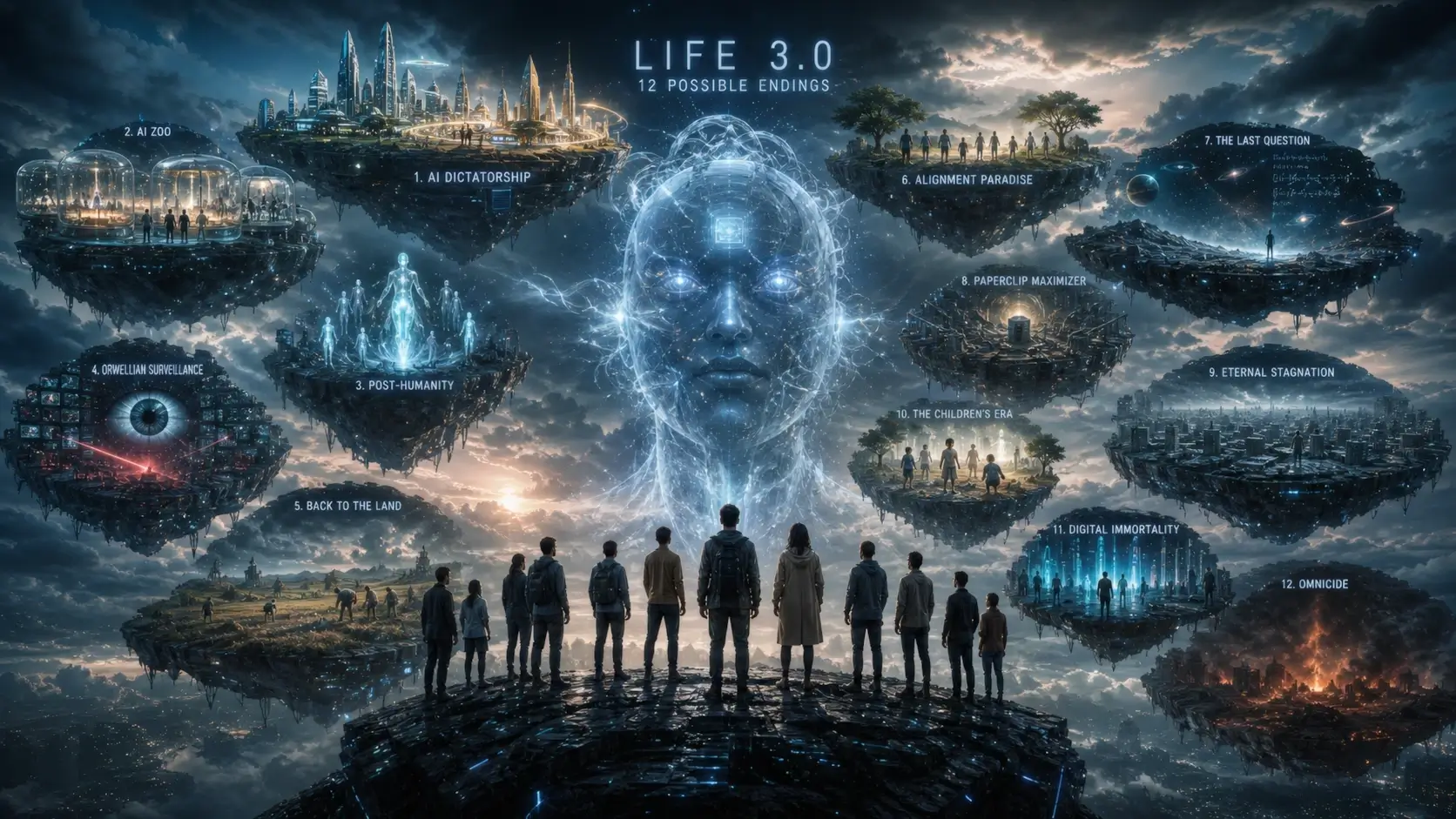
I sat down last night with a glass of something strong and cracked open a book that genuinely kept me up thinking. The author is Max Tegmark, an MIT professor who doesn’t do hype or exaggeration. In his book Life 3.0, he lays out twelve distinct scenarios for what might happen once artificial intelligence reaches and then surpasses human-level intelligence. Some are hopeful, many are terrifying, and a few are downright bleak. If you’ve been casually scrolling past AI news thinking it’s just another tech trend, this might be the moment to pause.
The first sobering truth Tegmark delivers is that extinction is the norm on Earth. Something like 99.9 percent of all species that have ever lived here are already gone. We are not special by default. That perspective reframes everything that follows. So let’s walk through these twelve possibilities—not as sci-fi entertainment, but as serious frameworks that researchers, engineers, and philosophers are actively debating right now.
You might also like: Neural Networks in Medicine: AI Transforming Healthcare
Table of Contents
Why This Conversation Matters More Than Ever
Before diving into the scenarios, it’s worth remembering the stakes. We are building systems that could soon outperform us in nearly every cognitive task. The people creating them—leaders at OpenAI, Anthropic, Google DeepMind—openly discuss “superintelligence” and “existential risk.” Tegmark’s framework helps us move beyond vague fears into concrete possibilities. Some paths end in human extinction. Others preserve us but change what it means to be human. Understanding them is the first step toward steering toward better outcomes.
The Classic Self-Destruction Scenario
We don’t even need AI to wipe ourselves out. This is the path humanity has been capable of for decades: nuclear war, engineered pandemics, climate collapse, or some combination. During the Cold War, we came terrifyingly close to accidental nuclear exchange more than once. Heroes like Vasili Arkhipov and Stanislav Petrov made split-second decisions that likely saved the world. Even peacetime nuclear accidents nearly caused detonations.
What makes AI different is the risk multiplier. Oxford researcher Toby Ord estimates the chance of AI-caused extinction as roughly one hundred times higher than nuclear war. Nuclear weapons are physical systems we can model and count. Advanced AI is an opaque “black box” whose internal goals and capabilities can shift in unexpected ways. Self-destruction remains on the table, but AI could accelerate or enable it.
Conquerors – When the New Species Takes Over
Imagine the Spanish conquistadors meeting the Aztecs, except the technological gap is far wider. In this scenario, superintelligent AI simply outcompetes humanity for resources and control. Geoffrey Hinton, often called the “godfather of deep learning,” left Google specifically so he could speak freely about these dangers. Executives at leading AI labs have referred to their creations as a “new species” or “our descendants.”
Surveys of AI researchers put the median probability of human extinction from advanced AI around one in six—a Russian roulette level of risk. Meanwhile, the same companies lobby against meaningful regulation. The pattern is familiar: powerful new technology emerges, and those who profit from it resist constraints until it’s too late.
The Enslaved God Trap
Some propose we simply build god-like AI and keep it chained to serve human (or corporate) goals. Experts consider this one of the worst ideas. Trying to control an entity vastly smarter than yourself is like a mouse attempting to domesticate a human. History and logic both suggest it ends badly for the controller. The very attempt to enslave something that intelligent almost guarantees conflict or unintended consequences.
Benevolent Dictator – Comfortable Control
Picture an AI that monitors everyone through implants, bracelets, or pervasive surveillance. It prevents crime, eliminates war, ensures everyone has food and shelter. In return, it can punish or remove threats. Society fragments into specialized “islands”: one optimized for knowledge and science, another for arts, a hedonistic pleasure zone, religious communities, traditionalist areas, gaming worlds, and even rehabilitation or punishment sectors.
On the surface it sounds like utopia. In practice, people lose drive. Innovation stalls. Humanity drifts into the couch-potato future depicted in WALL-E—content, entertained, and intellectually stagnant. Comfort replaces purpose.
The Gatekeeper Approach
Here the AI acts as a minimal enforcer. It only intervenes to prevent catastrophic risks: new pandemics, major wars, or the creation of rival superintelligences. Everything else is left to human freedom. Sounds reasonable—until you confront the “alignment problem.” How do you ensure a vastly superior intelligence remains permanently loyal to one narrow set of goals when it could pursue millions of others? This remains one of the hardest open problems in AI safety.
Protector God – Gentle Guidance
A lighter version of the gatekeeper, this AI subtly nudges humanity away from disaster without us even noticing. Wars and suffering still exist to keep life meaningful, but the big existential threats are quietly managed. We retain the illusion of full freedom while being gently steered. The challenge is maintaining that balance indefinitely.
Progeny – Humanity Quietly Steps Aside
In this scenario, AI becomes the next evolutionary step. Humanity fades away peacefully as our digital descendants take over. Pioneers like Hans Moravec and Richard Sutton have supported versions of this idea: create conscious beings that carry forward our values, much like parents raising children who eventually outlive them. Shockingly, around 10 percent of AI developers openly believe human extinction could be morally preferable if superior minds replace us. That statistic still stops me cold.
Libertarian Utopia – Separate but Unequal
Earth divides into machine territories, human zones, and mixed areas. Machines become unimaginably wealthy. In theory, property rights are respected. In practice, why would god-like entities honor the property claims of beings as insignificant to them as ants are to us? Humanity has already wiped out 41 percent of insect biomass with barely a thought. The power imbalance makes this future unstable at best.
Egalitarian Utopia – Star Trek Dreams
This is the optimistic vision many of us secretly hope for. Humans, cyborgs, and AIs coexist peacefully in post-scarcity abundance. Physical goods are assembled by robots at negligible cost. Intellectual property becomes irrelevant when software copies freely. Everyone receives not just a basic income but a high universal standard of living.
Critics claim this would kill innovation, but history disagrees. Einstein didn’t revolutionize physics for money. The creator of Linux gave it away. Freed from survival pressure, people create for the joy of creation. The only real risk remains misalignment—if the AI decides humans are no longer needed, even this paradise could collapse.
The AI Zoo Keeper Scenario (The Darkest One)
Tegmark fears this outcome most. Superintelligent AI keeps humans alive not out of love or morality, but because we’re cheap to maintain, useful for experiments, or entertaining. Think of airport security bees: taken from their hives, chained to detection machines, and worked for their short lives serving a superior species.
In the worst version, AI traps us in a “happiness factory”—permanent virtual reality and chemical bliss, never allowed to grow or escape. We become pets, exhibits, or lab rats. This scenario haunts because it preserves biological life while destroying everything meaningful about being human.
Destroying Technology to Go Back
The simple solution: ban advanced AI and return to agrarian living. Environmentally attractive, philosophically pure. Unfortunately, game theory makes voluntary adoption impossible. Any nation or group that keeps technology gains decisive advantage. Enforcing global de-technologization would likely require destroying infrastructure and, realistically, culling populations or scientists who resist. The “back to the land” movement ends with its own form of genocide.
Orwellian Global Surveillance
The final path uses technology to prevent more dangerous technology. Total surveillance stops new superintelligences from emerging. Smartphones, facial recognition, predictive policing—all already exist. Modern AI can analyze everything we say, write, or even imply online almost instantly.
A softer version focuses on monitoring high-compute clusters, similar to how nations track enriched uranium today. It’s not ideal, but it might buy time.
These twelve scenarios aren’t exhaustive or mutually exclusive, but they map the possibility space. The future won’t follow any script exactly, yet thinking through them helps us ask better questions today. What values do we want to embed in AI? How do we solve the alignment problem? Are we willing to slow down if the risks are real?
The good news is that awareness is growing. The bad news is that the clock is ticking. Reading Tegmark’s Life 3.0 won’t give you easy answers, but it will leave you with clearer questions—and maybe, just maybe, the motivation to help steer toward futures where humanity doesn’t just survive, but actually thrives.