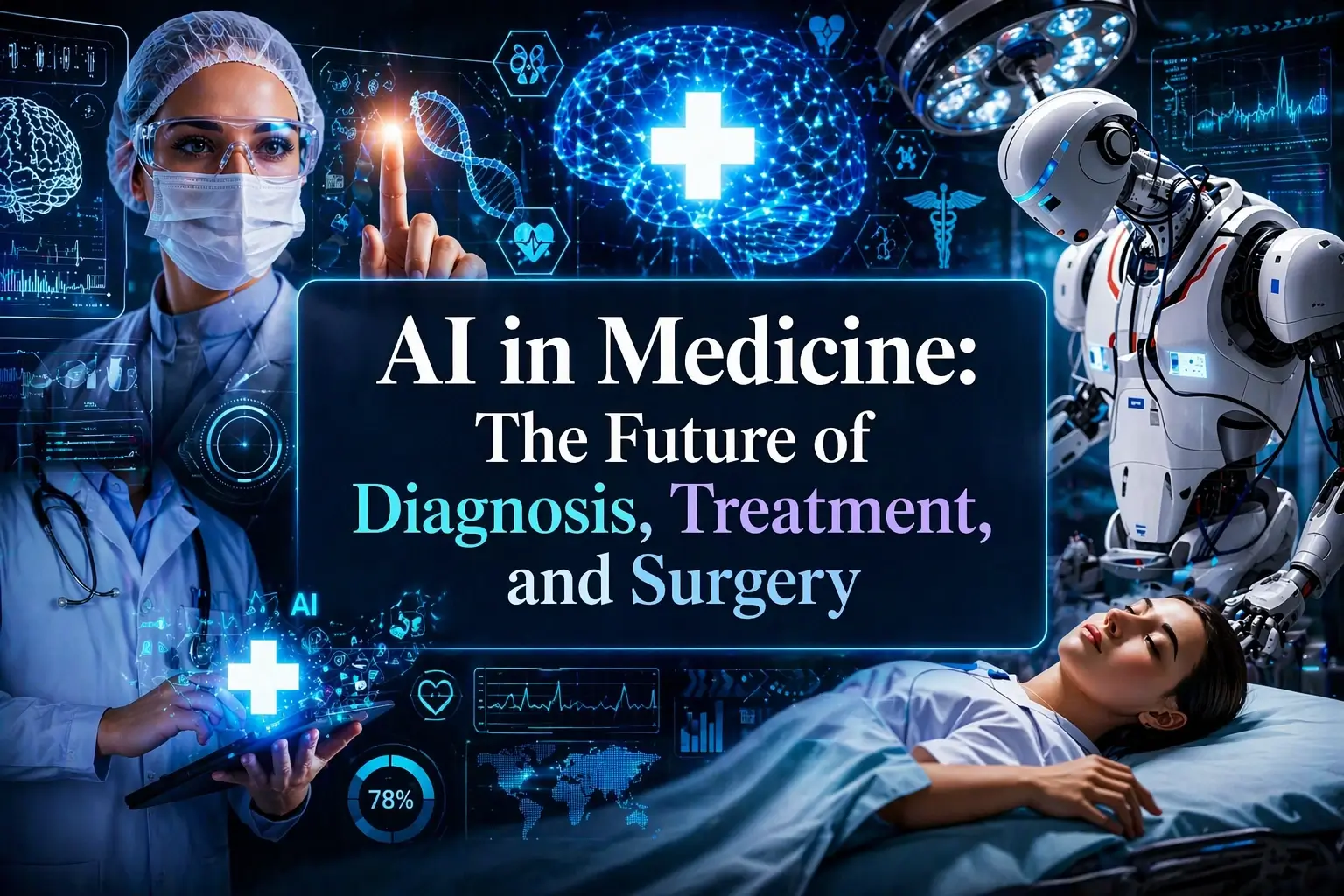
Neural Networks in Medicine: How Artificial Intelligence Is Already Reshaping Healthcare
By mid-2025, the U.S. Food and Drug Administration (FDA) had approved more than 1,250 medical devices powered by artificial intelligence. In 2024 alone, 253 new systems entered the market. This is no longer a futuristic concept or a set of isolated experiments — it’s a functioning layer of modern healthcare infrastructure.
But it’s important to set expectations correctly. Neural networks are not replacing doctors. Instead, they are becoming powerful tools that enhance clinical decision-making: helping physicians analyze medical images faster, detect diseases earlier, predict treatment outcomes, and even design new drugs.
The real question today is no longer whether AI will be used in medicine. It already is — in thousands of hospitals worldwide. The more relevant question is how it works in practice, what results it delivers, and where its limits lie.
The discussion around AI's capabilities and how it operates continues to expand, even exploring groundbreaking concepts like Hybrid Bio-AI Computing: How Rat Brain Neurons Are Powering Artificial Intelligence.
Table of Contents
What Neural Networks Mean in Medicine
At its core, a neural network is a machine learning model inspired by the structure of the human brain. It consists of layers of artificial neurons that process data, identify patterns, and improve through training.
In healthcare, these models are trained on vast datasets: X-rays, CT scans, MRI images, lab results, patient histories, and even genetic information. Once trained, they can analyze new data and assist clinicians in diagnosing conditions, choosing treatments, or predicting outcomes.
What makes neural networks fundamentally different from traditional software is their flexibility. Instead of following rigid, predefined rules, they learn patterns directly from data — often uncovering subtle signals that human observers might overlook.
Where AI Is Already Making an Impact
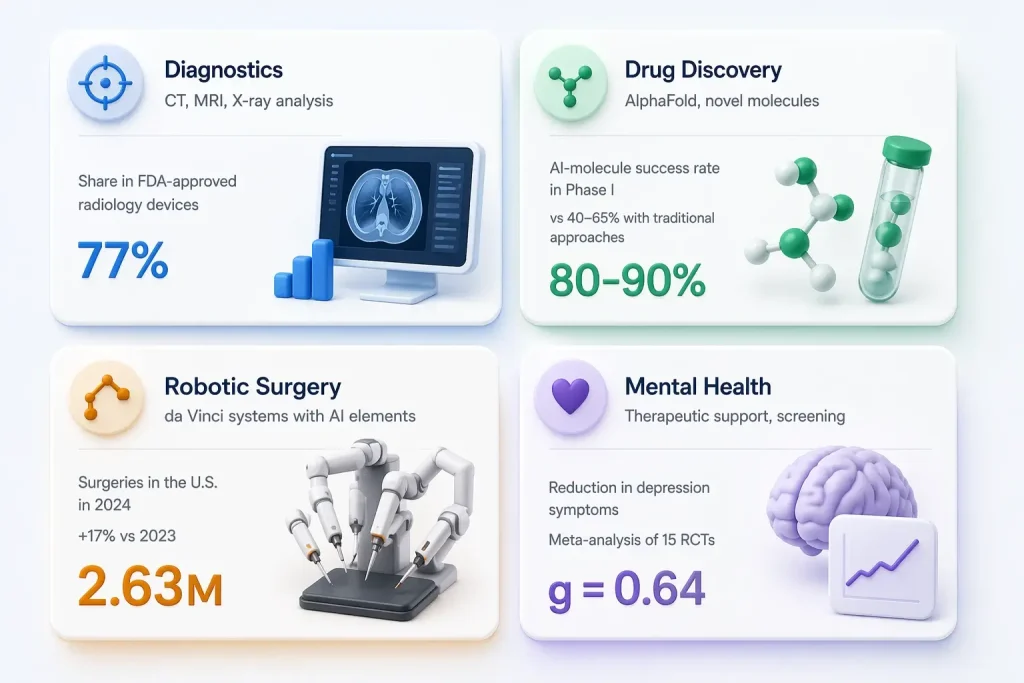
The use of neural networks in medicine spans multiple domains. Some applications are already deeply integrated into clinical workflows, while others are still emerging but advancing rapidly.
Together, they point to a broader shift: healthcare is becoming more data-driven, predictive, and personalized.
Diagnosis: When Algorithms See What Humans Miss
Medical imaging is currently the most mature and widely adopted application of AI in healthcare. According to FDA data, roughly 77% of approved AI devices are used in radiology.
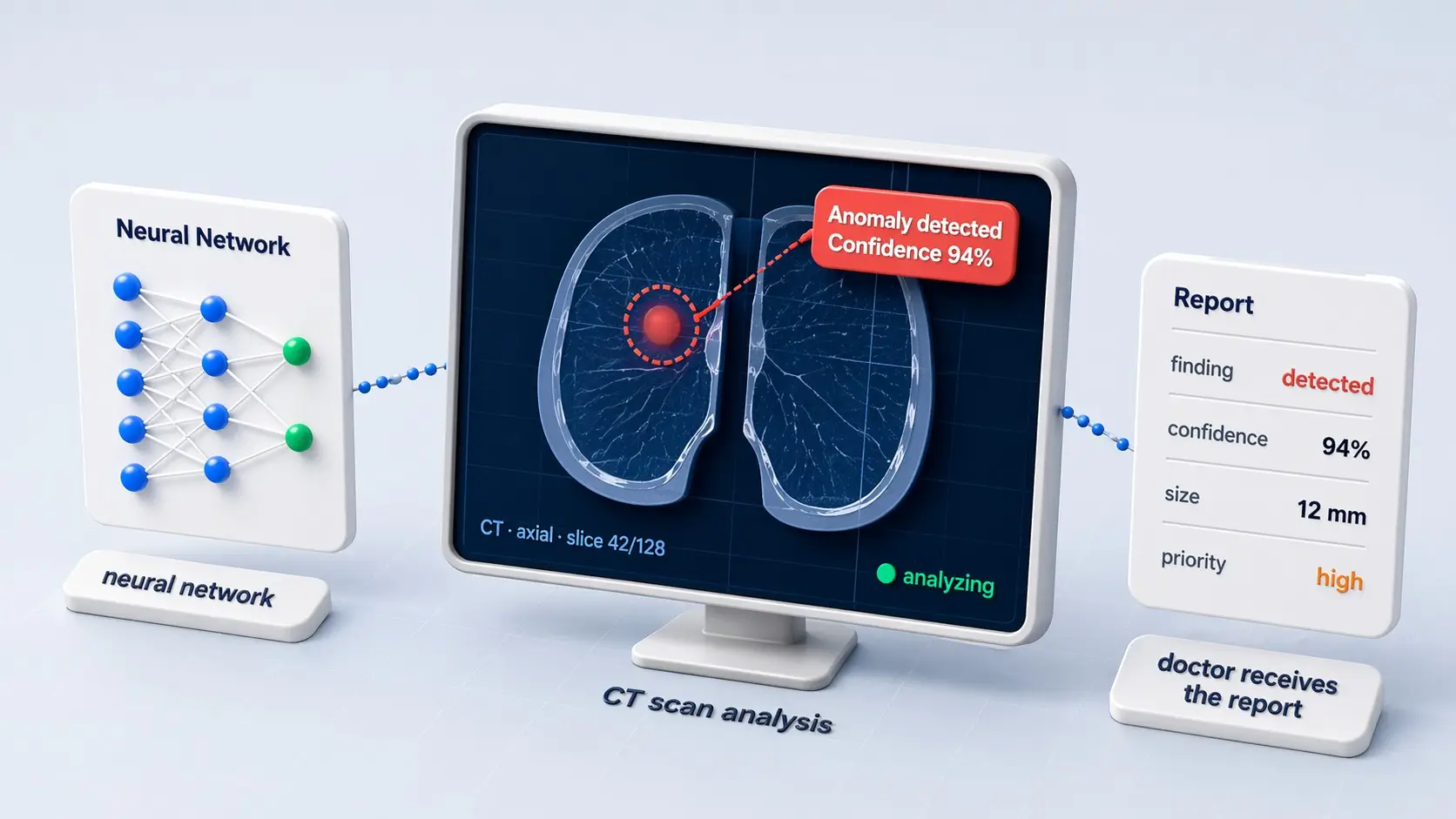
In practice, the workflow is straightforward. A physician uploads an image — such as a CT or MRI scan — into an AI system. The neural network analyzes it and highlights regions that may indicate abnormalities. It doesn’t replace the diagnosis but acts as a second set of eyes.
And in some cases, those “eyes” are exceptionally sharp.
Take stroke detection. The AI system Viz.ai has been shown to reduce time to treatment by about an hour. In stroke care, that difference is critical — every minute can mean irreversible brain damage. (Intuition Labs)
In dermatology, neural networks have demonstrated higher sensitivity in detecting melanoma compared to human specialists. (Marchetti et al., 2024) This doesn’t mean they are “better doctors,” but they are less likely to miss dangerous cases.
Perhaps the most interesting finding is what happens when AI and humans collaborate. Studies show that when clinicians receive AI-assisted insights, diagnostic accuracy improves across all experience levels — from medical students to seasoned dermatologists.
Drug Discovery: From Decades to Months
Developing a new drug has traditionally been one of the most time-consuming and expensive processes in science, often taking 10 to 15 years and billions of dollars.
Neural networks are beginning to change that.
By analyzing protein structures, predicting molecular interactions, and generating entirely new compounds, AI systems can significantly accelerate early-stage research. Instead of testing millions of possibilities blindly, researchers can focus on the most promising candidates from the start.
One of the most significant breakthroughs in this area is AlphaFold, developed by DeepMind. This system can predict the three-dimensional structure of proteins with near-experimental accuracy. Its database now contains over 200 million predicted protein structures and is used by millions of researchers worldwide.
The impact is already measurable. Studies indicate that AI-designed drug candidates have higher success rates in early clinical trials, suggesting better initial selection and fewer failures due to toxicity or inefficiency.
And this is no longer theoretical. Some AI-developed drugs have already entered clinical trials and are showing promising results.
Robotic Surgery and the Rise of AI Assistance
Robotic-assisted surgery has been steadily growing, with systems like da Vinci already used in millions of procedures annually. In the United States alone, the number of such surgeries has surpassed 2.6 million per year. (AHA, 2025)
The benefits are well documented: reduced blood loss, fewer complications, shorter hospital stays, and faster recovery times.
AI is now adding another layer to this technology.
Recent research shows that machine vision models can be trained on surgical videos to perform specific tasks autonomously — such as handling needles or suturing. In experimental settings, robotic systems have demonstrated the ability to adapt to unexpected situations, like recovering a dropped surgical instrument and continuing the procedure.
While this is not yet standard clinical practice, it clearly signals the direction of progress. AI is gradually taking over repetitive, precision-based steps, allowing surgeons to focus on complex decision-making.
Mental Health and Digital Therapy
Not all applications of neural networks in medicine are tied to physical health. Mental health is another area where AI is making a noticeable impact.
AI-driven tools are being used for emotional support, depression screening, and continuous patient monitoring between therapy sessions. These systems are not replacements for human therapists, but they provide an accessible alternative for people who might otherwise receive no support at all. (He et al., 2023)
Research shows that AI-based interventions can significantly reduce symptoms of depression and psychological distress. One of the key advantages is availability — these systems can operate 24/7, without geographical or financial barriers.
Adoption Challenges and Regional Differences
The integration of AI into healthcare varies significantly across regions. While countries like the United States and members of the European Union have more established regulatory frameworks, other regions are still developing standards and infrastructure.
In places like Russia, for example, AI adoption is progressing through pilot projects and specialized solutions, particularly in medical imaging and clinical decision support systems.
However, several challenges remain: lack of standardized validation methods, unclear legal responsibility in case of errors, and the complexity of integrating AI into existing hospital systems.
Limitations and Ethical Questions
Despite its potential, AI in medicine comes with real limitations.
One of the most discussed issues is the “black box” problem. Neural networks can produce highly accurate results, but their internal decision-making process is often difficult to interpret. This raises concerns about trust and accountability.
Another challenge is data bias. AI models learn from the data they are trained on, and if that data is unbalanced, the system may perform хуже for certain populations. This has already been observed in areas like dermatology and cardiovascular risk assessment.
Legal responsibility is another unresolved issue. If an AI system contributes to a medical error, who is accountable — the doctor, the developer, or the healthcare institution?
Finally, not all AI systems undergo rigorous clinical validation across diverse patient groups. This creates uncertainty about how well they generalize in real-world settings.
The Future of AI in Healthcare
Looking ahead, the role of neural networks in medicine is expected to expand significantly.
Personalized medicine is one of the most promising directions. By analyzing genetic data, medical history, and lifestyle factors, AI can help tailor treatments to individual patients.
Predictive diagnostics is another breakthrough area. Neural networks are increasingly capable of identifying disease risks before symptoms appear, enabling earlier interventions.
Integration with wearable devices opens the door to continuous health monitoring in real time, potentially transforming preventive care.
And then there’s autonomous surgery. While still in the research phase, it’s becoming increasingly clear that AI will play a larger role in surgical procedures — not replacing surgeons, but augmenting their capabilities.
Final Thoughts: Doctors and AI, Not Doctors vs AI
Neural networks in medicine are no longer a vision of the future — they are part of everyday clinical reality. Thousands of systems are already in use, helping doctors make faster and more accurate decisions.
But the key point remains: AI is a tool, not a replacement.
The best outcomes emerge when human expertise and machine intelligence work together. Doctors bring context, ethics, and experience. AI brings speed, scale, and pattern recognition.
So the real question becomes surprisingly simple: would you trust a doctor who uses AI as part of their toolkit?
Given the evidence, that might actually be the smarter choice.
FAQ
What are neural networks in medicine?
Neural networks in medicine are machine learning models trained on clinical data—such as medical images, lab results, and patient histories—to assist doctors in diagnosis, treatment decisions, and outcome prediction.
How are neural networks used in healthcare today?
They are widely used in medical imaging (CT, MRI, X-rays), drug discovery, robotic surgery, mental health support, and predictive diagnostics. The most common application is detecting diseases from medical images.
Can AI diagnose diseases better than doctors?
In some specific tasks, like image recognition, AI can match or even exceed human performance. However, the best results come from collaboration—AI supports doctors, but does not replace clinical judgment.
What is AlphaFold and why is it important?
AlphaFold is an AI system developed by DeepMind that predicts the 3D structure of proteins. This breakthrough significantly ускорил drug discovery and earned its creators the 2024 Nobel Prize in Chemistry.
What are the risks of using AI in medicine?
Key risks include lack of transparency (“black box” decisions), data bias, limited clinical validation, and unclear legal responsibility in case of errors.
Will neural networks replace doctors?
No. Neural networks are tools that enhance medical practice. Doctors remain essential for interpreting results, making decisions, and providing patient care.
What is the future of AI in medicine?
The future includes personalized medicine, early disease prediction, integration with wearable devices, and increased use of AI in surgical assistance.