
Wireless Optical Communication Reaches 362 Gbps Speed Indoors
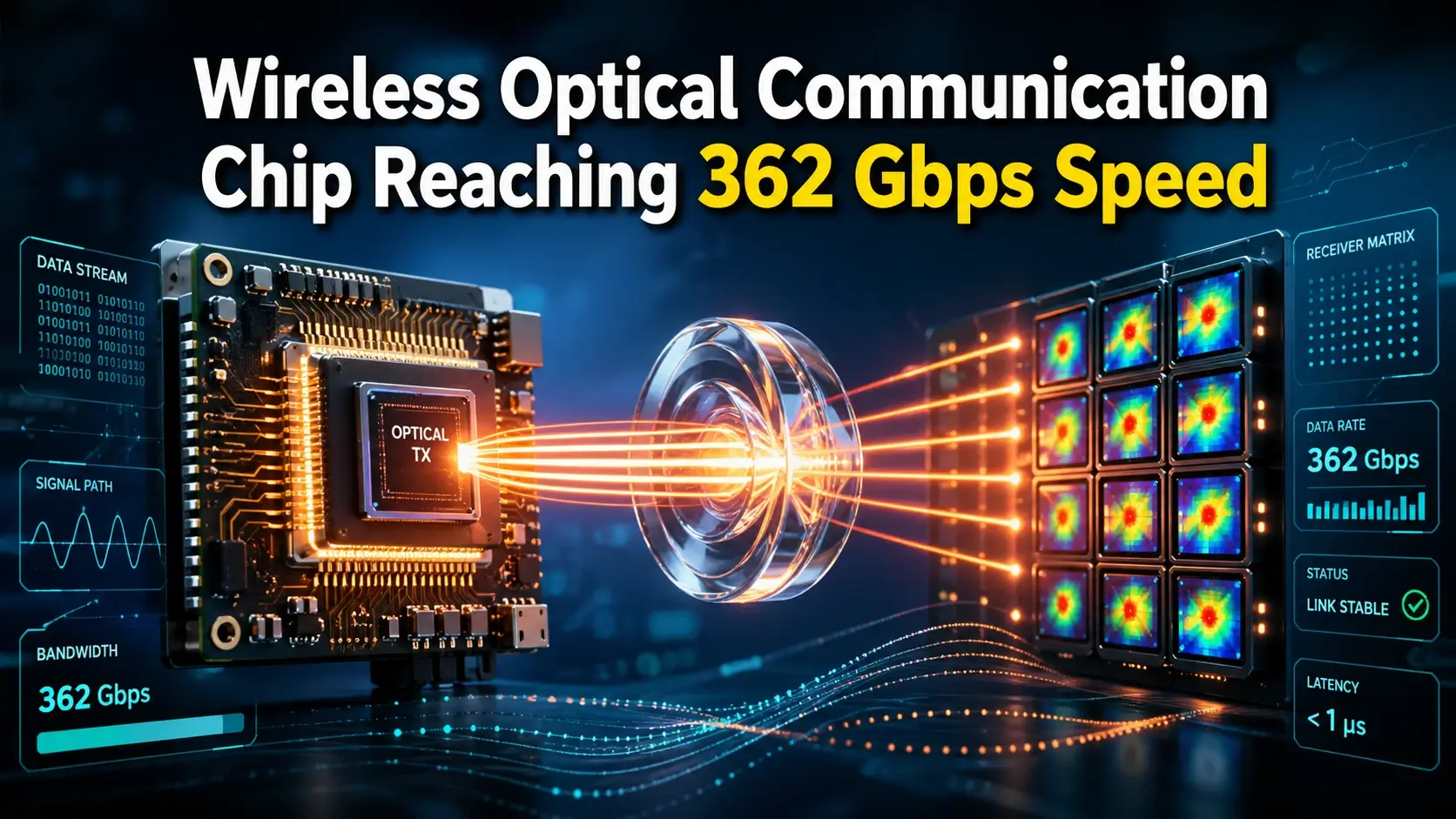
Engineers from the International Society for Optics and Photonics (SPIE) have reported a breakthrough in indoor wireless optical communication, achieving data transmission speeds of up to 362.7 Gbps in laboratory conditions.
The new system significantly outperforms conventional Wi-Fi and cellular networks and is designed to complement existing wireless technologies in indoor environments such as homes, offices, and data centers.
Technical Details
The system is based on a compact chip, less than a millimeter in size, featuring an array of vertical-cavity surface-emitting lasers (VCSELs). The chip uses a 5×5 matrix configuration, where each laser operates independently to transmit separate data streams.
Instead of radio waves, the technology relies on light for data transmission. A specialized optical setup with microlenses directs each beam, forming a uniform grid of coverage over a distance of up to two meters without interference. The experiment was conducted in a standard indoor setting with the transmitter and receiver separated by this distance.
To maximize throughput, the researchers used multi-channel modulation. In testing, 21 out of 25 lasers were active, each delivering speeds of up to 19 Gbps. The overall performance was limited by a commercially available photodetector, suggesting that higher speeds may be achievable with more advanced components.
Advantages and Use Cases
A key advantage of the system is its energy efficiency. The transmission of one bit of data required approximately 1.4 nJ, about twice as efficient as radio-frequency-based communication technologies.
Because optical communication does not suffer from radio interference, it is particularly well suited for dense environments such as offices, hospitals, data centers, and residential spaces with many connected devices.
The compact design allows integration into lighting systems, access points, and other infrastructure. In multi-user scenarios, the system can distribute bandwidth across several devices simultaneously. During testing, researchers demonstrated four independent communication channels operating at high speeds.
Context and Outlook
Wireless optical communication is seen as a way to offload traffic from congested Wi-Fi networks while reducing overall energy consumption as data demand continues to grow.
Developers emphasize that the technology is not intended to replace existing wireless standards but to complement them. In the future, it could support high-bandwidth applications such as video streaming, virtual reality, and IoT ecosystems, offering faster and more energy-efficient connectivity indoors.
Source: ScienceDaily